
A set of dirt bike graphics can come back from one summer looking like it was printed in three different batches. The shrouds go chalky while the number plates hold their color; the swingarm decals yellow while the front fender stays sharp. The usual cause is the clear overlaminate on top, how much UV it blocks, and whether that protection is consistent from panel to panel. Check that before you order a reprint, not after.
The overlaminate is the transparent film laminated over the printed vinyl graphic. It takes most of the ultraviolet radiation, so when its UV stabilization is weak or uneven, the ink underneath degrades at different speeds across the same sheet. The result is a bike that looks patchy rather than evenly worn.
That unevenness also sends people down the wrong path on reprints. A shop blames the artwork or the ink when the variable that actually changed was the laminate batch or the supplier’s formulation. Reprint on the same unverified film and the next set fails the same way.
What follows covers why the fading is uneven, how to read it off a spec sheet, and what has to change before a reprint is worth paying for. Layer order matters, because each layer is what the next step builds on.
The Mechanics of Uneven UV Fading
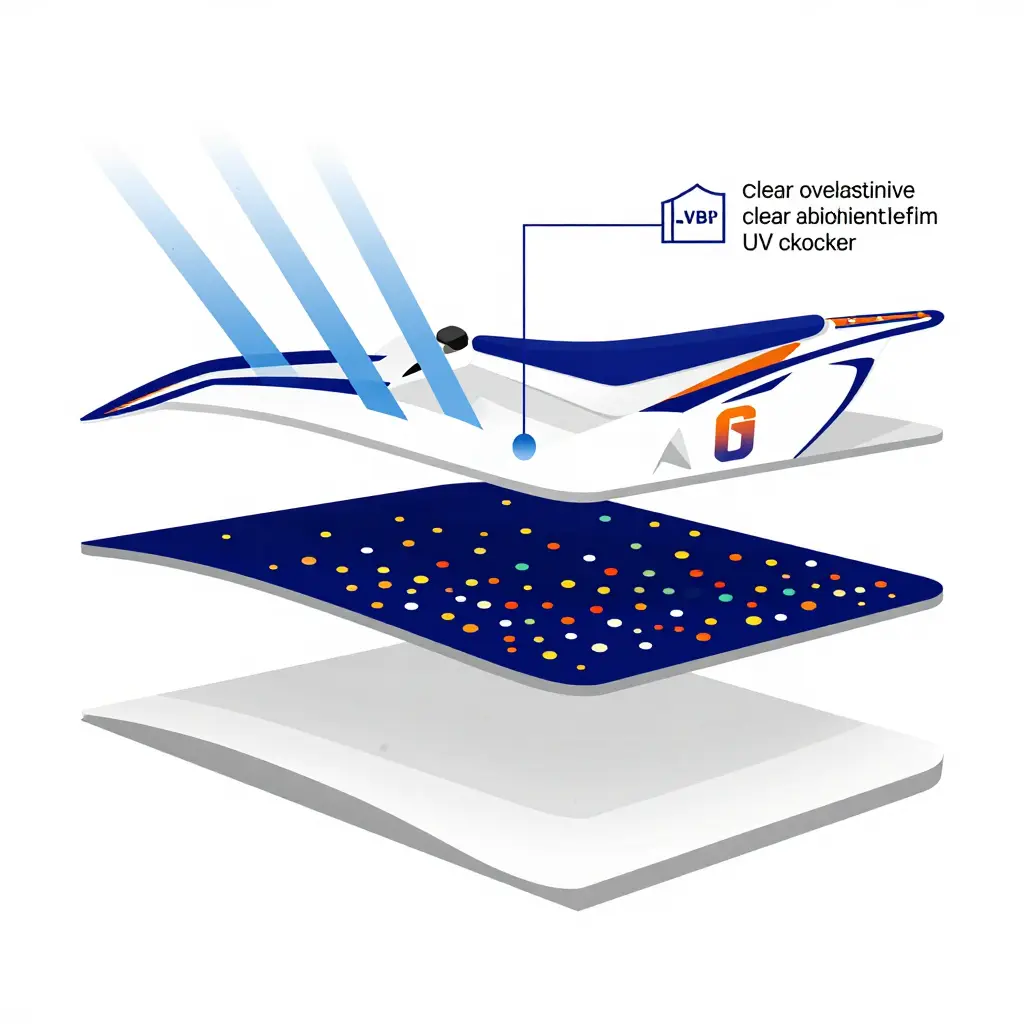
Uneven Fade Is a Materials Problem
Riders usually blame “too much sun” for faded graphics, and sun time does matter. But uneven UV fade is more about what the graphic is made of. A decal is a stack of layers, and each one reacts to ultraviolet (UV) radiation at its own rate. Once those rates diverge, color drops out in patches instead of fading evenly.
- UV fade: the gradual loss of color and gloss caused by ultraviolet radiation.
- Printed vinyl: a base vinyl film carrying ink, normally sealed under a clear top film.
- Overlaminate: the clear protective film bonded over the ink layer.
No two spots on a bike get the same sun, so the stack never fails uniformly.
Three Layers, Three Breakdown Rates
UV radiation breaks a graphic down through three routes, one per layer.
1. Ink pigment breakdown. UV photons carry enough energy to snap chemical bonds inside pigment molecules. Organic pigments, which include many reds and yellows, are more vulnerable than inorganic ones, so they fade first. That is why a single decal can shift color unevenly across its own surface.
2. Vinyl resin oxidation. The printed vinyl base is a PVC resin blended with plasticizers. UV exposure oxidizes that resin, which shows up as chalking, brittleness, and lost gloss. Surfaces that face the sun collect more UV per unit area, so they weather faster than panels angled away.
3. Overlaminate consumption. Clear overlaminates contain UV blockers, absorbers and stabilizers, that sacrifice themselves to shield the ink below. Once the blocker is depleted, UV reaches the pigment directly. Laminate thickness and blocker load set how long that shield survives.
Three variables shift the rate further:
| Variable | Effect on fade rate |
|---|---|
| Panel orientation | Surfaces facing the sun collect more UV per unit area |
| Film type | Cast vinyl resists UV better than calendared film |
| Print method | Solvent, latex, and UV-cured inks age at different speeds |
The Overlaminate Decides the Fade
Ink and vinyl matter, but the overlaminate is the primary defense. Its UV resistance determines how evenly, and how long, a graphic holds its color. Before you reprint, compare custom dirt bike graphics and check the laminate’s UV rating and thickness first. That specification tells you more about the fade you will actually see than the number of sunny days does.
Uneven fade is a layered-materials outcome, so the fix belongs at the source: a thicker overlaminate with higher UV resistance slows the fade before it starts.
Before you reprint, compare your custom dirt bike graphics overlaminate options side by side. The clear film bonded over your print is what ultimately decides whether your colors hold or fade unevenly after a season in the sun.
| Overlaminate Type | UV Resistance Rating | Expected Fade-Protection Duration | Surface Finish | Suitability for Reprint |
|---|---|---|---|---|
| Standard cast gloss laminate (no added UV package) | Moderate, baseline cast film blocks some UV but relies on base ink stability | 12-18 months of regular sun exposure | High-gloss, wet-look reflective | Good, reprints match easily and color profiles stay predictable |
| Matte laminate with UV blockers | High, integrated UV absorbers (UVA/HALS) shield the ink layer | 24-36 months before noticeable fade | Low-sheen, flat matte, anti-glare | Good to excellent, ideal for reprints needing a consistent flat finish |
| UV-inhibited laminate (UV-stabilized, high-solids) | Very high, engineered UV-stabilized film plus concentrated inhibitors | 36-60 months under typical trail and track conditions | Gloss, satin, or matte depending on grade | Excellent, longest service life and most repeatable reprints |
| Low-cost economy laminate (thin caliper, minimal UV package) | Low, limited UV screening, degrades quickly | 6-9 months before uneven fade and yellowing | Gloss, thin and prone to orange-peel | Poor, reprints show mismatched color and require fresh film sourcing |
Read across the table and the gap is wide: a UV-inhibited or matte UV-blocker laminate extends the fade-protection window roughly four to six times beyond economy film. If even fading across the whole season matters to your riders or to your shop’s reprint reputation, choose a UV-stabilized overlaminate and skip the cheap economy roll entirely.
Reading Overlaminate UV Specifications
When dirt bike graphics kits fade unevenly after a season, the print is rarely the problem. The overlaminate, that thin clear film on top, is what actually absorbs the sun’s punishment. Learn to read its spec sheet and you can predict how your next set of custom dirt bike graphics will hold up before you ever reprint.
Those specs are a forecast, not marketing filler. Higher blocking percentages, thicker films, and longer test hours all translate into more seasons of crisp color.
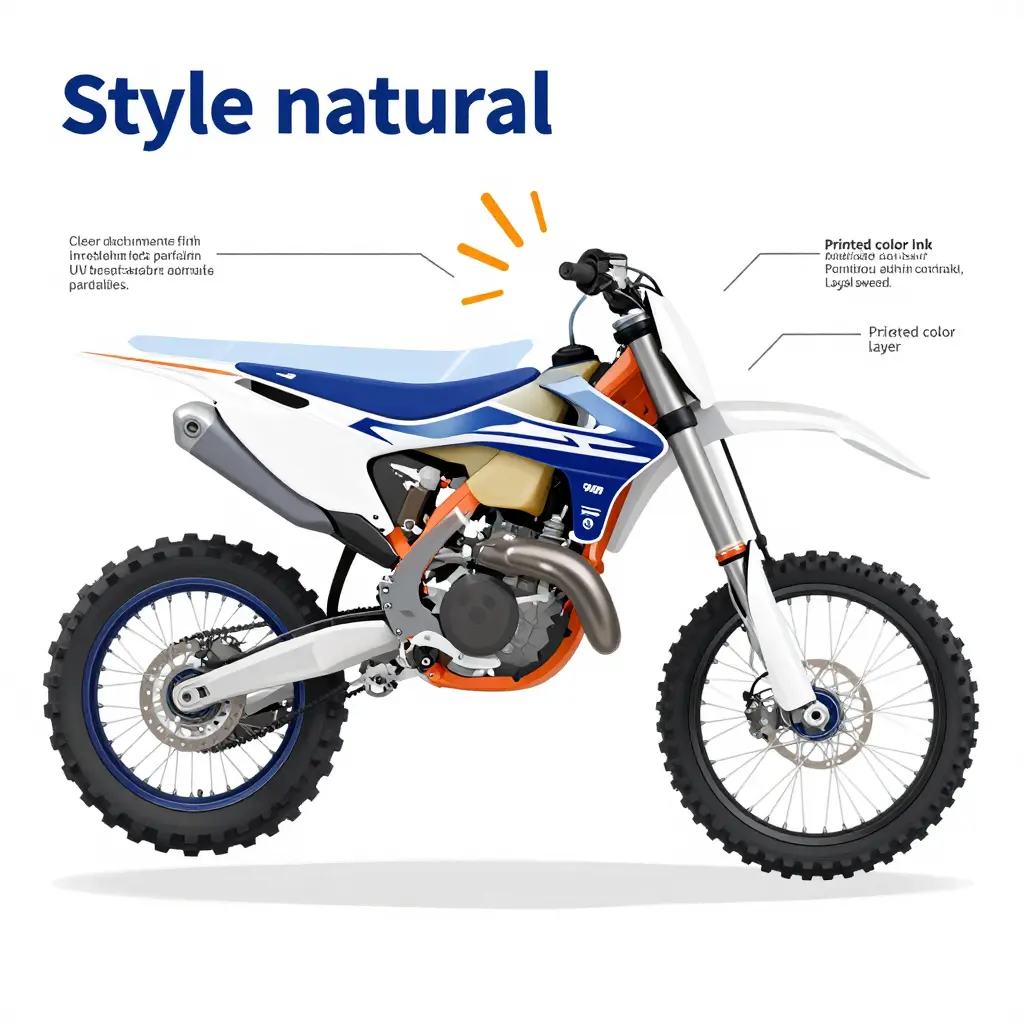
UV Blocking Percentage
This is the headline metric. It tells you what share of ultraviolet radiation the laminate rejects before it reaches the ink underneath.
- 99% blocking sounds excellent, but the remaining 1% still pounds the print across thousands of sun hours.
- Compare 95%, 98%, and 99% on the same basis. Each extra percentage point compounds over a full season.
- Where UV blocking is not listed, treat the spec sheet as incomplete.
Weatherability and Fade-Resistance Ratings
These two are related but distinct. Weatherability describes how the laminate survives UV, moisture, and temperature swings. Fade resistance describes how well the printed ink keeps its color. A great laminate over weak ink still fades, so check both.
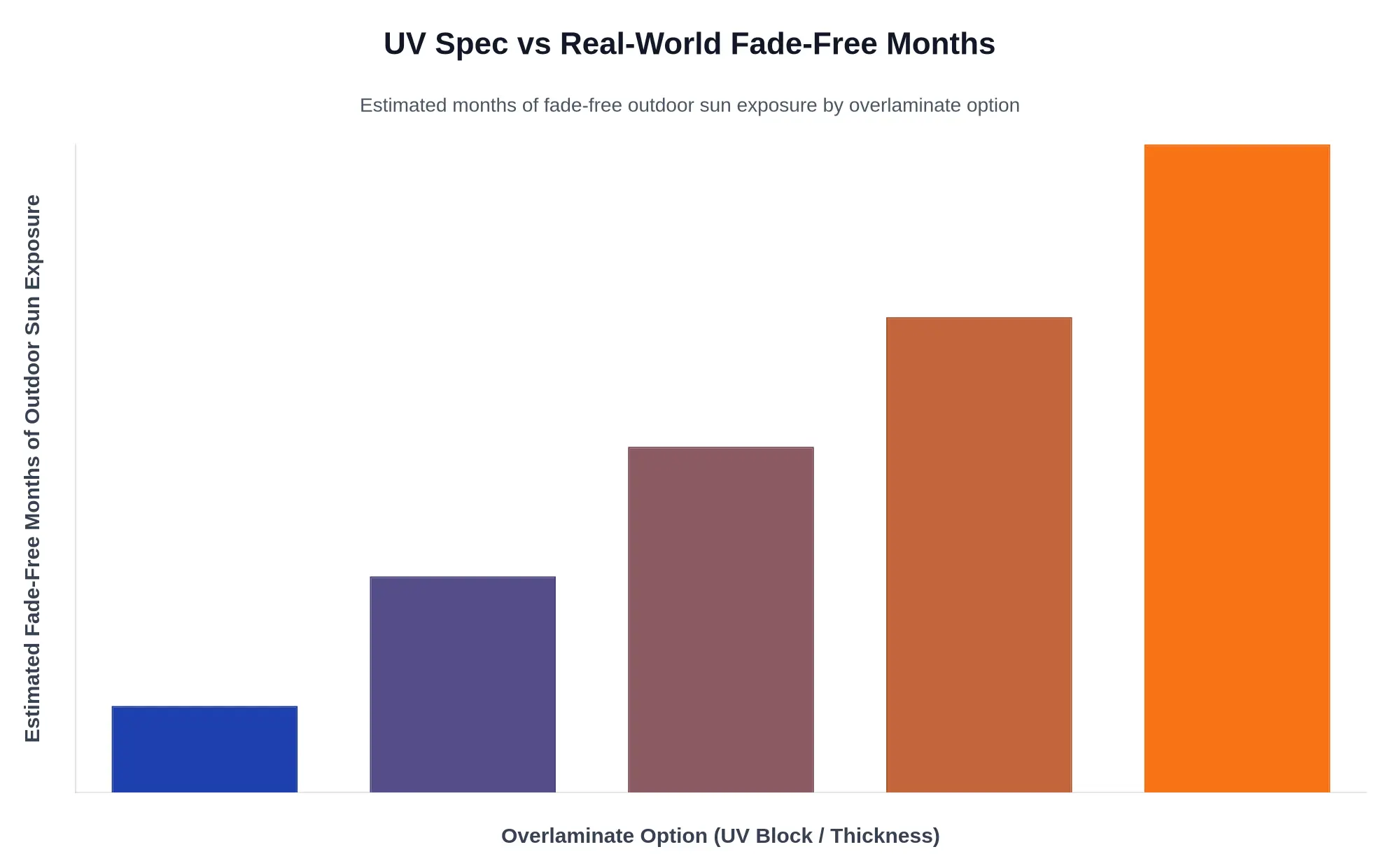
Accelerated UV Testing Standards
Laboratory standards compress years of sunlight into weeks. Watch for these two in a spec sheet:
- ASTM G154 (QUV) – fluorescent UV lamps with condensation cycles.
- ASTM G155 (xenon-arc) – full-spectrum simulation closest to real sun.
As a rule of thumb, roughly 1,000 hours of QUV exposure approximates one year of outdoor service, though high-altitude and desert riding shortens that window.
Laminate Thickness
Thickness determines how much UV absorber the film can hold. A 2-3 mil gloss looks clean but depletes quickly under intense sun. A 6-10 mil film carries a deeper reservoir and resists roost and pressure-washing far better.
| Spec | Typical Range | What It Predicts |
|---|---|---|
| UV blocking | 90-99% | Share of UV rejected before the ink |
| QUV hours | 500-2,000 h | Accelerated exposure before visible fade |
| Laminate thickness | 3-10 mil | UV absorber reservoir and physical durability |
| Adhesive type | removable / permanent | Repositionability on plastic fairings |
Which Specs to Prioritize When You Reprint
Rank them in this order: UV blocking at 99% or higher, then 6 mil or thicker laminate, then documented QUV or xenon-arc hours. Together they protect the color that dirt bike owners actually paid for. When your specs line up with real sun exposure, reprints stay sharp. If you would rather skip the guesswork, look at durable custom dirt bike graphics built around a high-UV overlaminate so the next season looks nothing like the last one.
Reading the Signs: How to Tell if UV Resistance Has Degraded
Before you approve a reprint, look for the cues that an overlaminate’s UV resistance is starting to fail. They show up first on custom graphics for dirt bikes that sit in direct sunlight and take repeated wash cycles all season long.
- Localized color shift. Isolated patches drift toward yellow, pink, or a washed-out tone while adjacent areas hold their original hue. The pigment layer beneath the laminate is breaking down at different rates.
- Chalking or hazing. The laminate develops a fine, powdery white residue or a milky haze that cannot be wiped away. UV radiation has broken down the polymer binder at the film’s surface.
- Edge lifting. Corners and edges begin to curl or peel because prolonged UV exposure has embrittled the overlaminate. It loses the elasticity that let it conform to flexing plastic body panels.
- Mismatched coverage between panels. Shrouds, side plates, and number plates fade at noticeably different rates, which points to inconsistent UV protection or uneven film thickness across a single graphics kit.
- Gloss loss. A once-crisp finish turns dull and matte as micro-cracking scatters incoming light. That is an early indicator that the clear coat is near the end of its protective service life.
If two or more of these symptoms appear together, the overlaminate can no longer shield the ink below. Before investing in another round of decals, it is worth rethinking how you reprint your custom dirt bike graphics with a higher-UV-grade film.
Fade Severity Index by Overlaminate Category
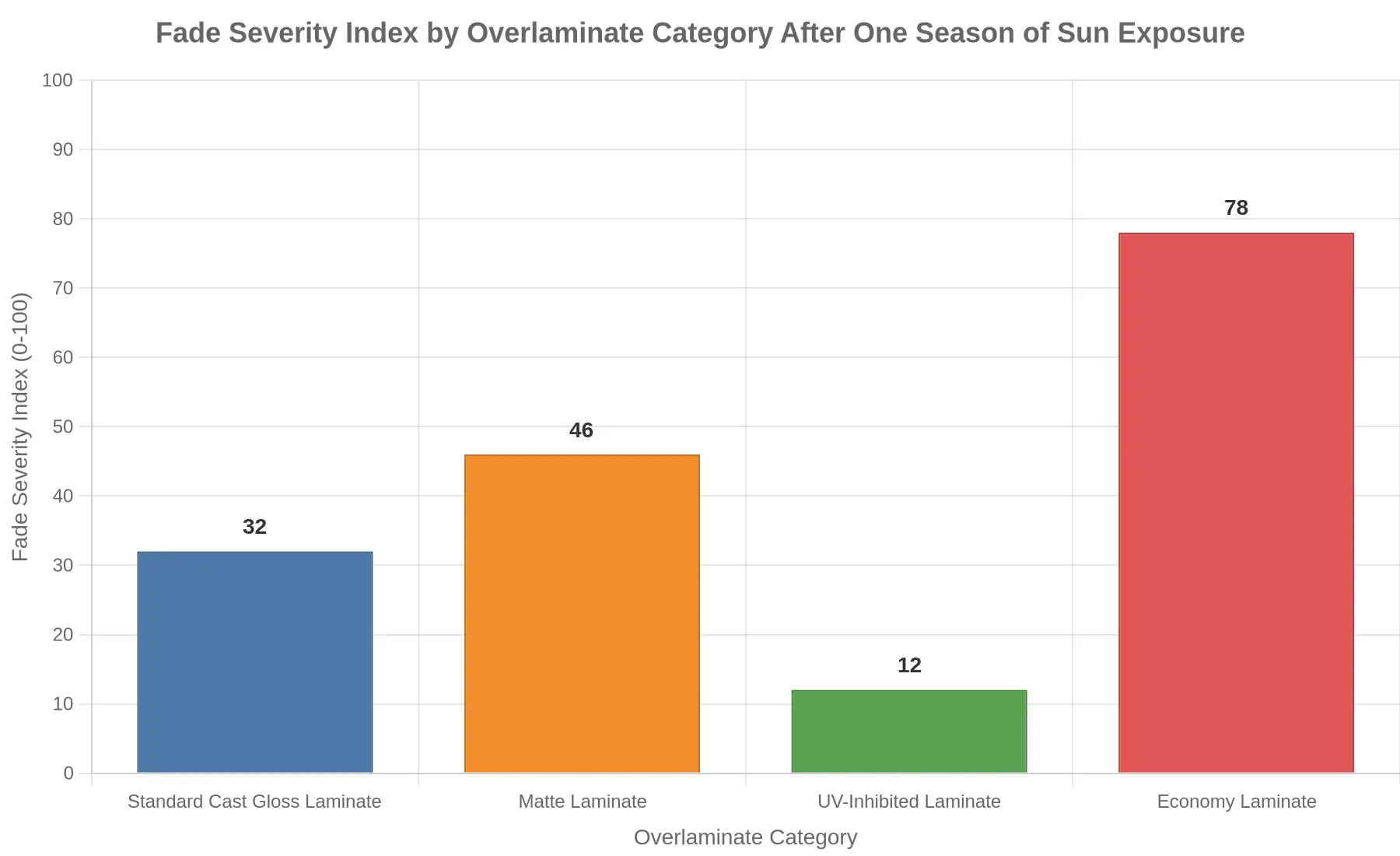
Chart caption: Bar chart comparing the fade severity index (0-100) across four overlaminate categories after one season of sun exposure. Higher bars indicate greater color-shift and fading on custom dirt bike graphics printed with each laminate.
| Overlaminate Category | Fade Severity Index |
|---|---|
| Standard Cast Gloss Laminate | 32 |
| Matte Laminate | 46 |
| UV-Inhibited Laminate | 12 |
| Economy Laminate | 78 |
Interpretation: UV-inhibited laminate delivered by far the lowest fade severity (12), while economy laminate faded most aggressively at 78, nearly six and a half times worse. Standard cast gloss (32) and matte laminate (46) sit in the middle, which says that even a quality gloss finish still shifts noticeably without dedicated UV protection. The matte figure here applies to a standard matte film without an added UV-blocker package, not the matte-with-blockers grade listed earlier.
Reprint or Replace? The Overlaminate Decides
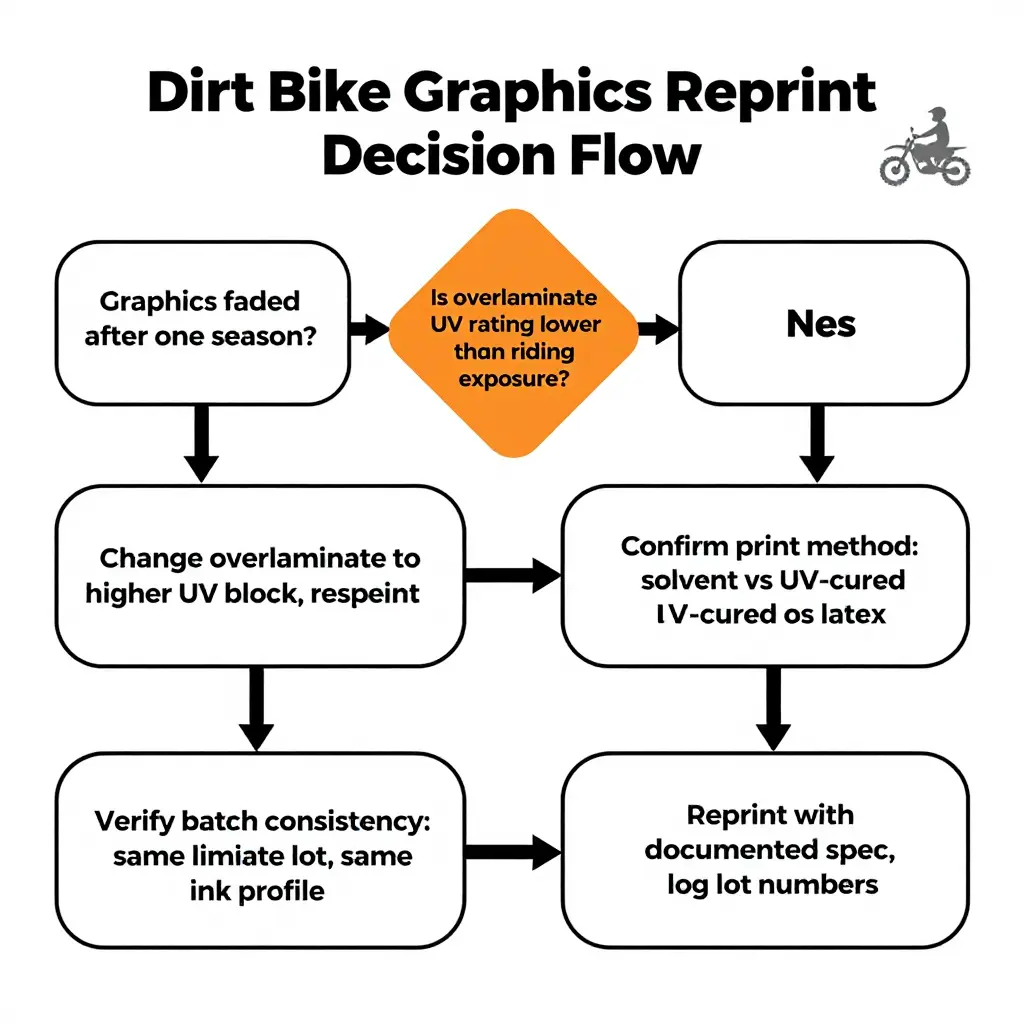
A reprint should be a fix, not a guess. If your dirt bike graphic kits faded unevenly after a single season, reprinting the same artwork on the same stock simply reproduces the same failure on the same schedule. The ink layer is rarely the weak link; the overlaminate is. UV degradation happens in the clear film sitting on top of the print, so if that film’s UV resistance does not match your actual riding exposure, every reprint you buy will fade again.
The decision rule is short: reprint only when the overlaminate specification changes. Same film, same result.
Evidence to Gather Before You Cover a Print Run
1. Match laminate UV resistance to real riding exposure
Laminate is rated by UV block percentage and by expected outdoor service life. Those ratings have to survive your geography, not a lab’s idea of “outdoor.” High-altitude desert tracks, summer parking in direct sun, and regular pressure-washing all accelerate breakdown.
| Riding exposure profile | Annual UV load | Laminate approach |
|---|---|---|
| Indoor arena / shaded storage | Low | Standard 2 mil gloss laminate is usually adequate |
| Mixed trail and track, garage kept | Moderate | Mid-grade UV-block laminate, 3-5 year rating |
| Desert, high altitude, year-round sun | High | High UV-block cast laminate, 5-7 year rating minimum |
| Coastal plus salt and sand abrasion | High | High UV-block laminate plus thicker film for scuff resistance |
2. Confirm the print method
Solvent, eco-solvent, UV-cured, and latex inks age differently under the same film. Solvent prints need full outgassing before lamination or the film will lift; UV-cured prints resist fading better but can crack if a low-tolerance laminate is stretched over sharp shroud edges. Confirm the ink set before you approve the film, because the laminate has to be compatible with both the ink and the substrate.
3. Verify batch consistency
Fade is uneven because batches are uneven. Ask for lot numbers on the laminate, the media, and the ink profile used for the reprint. If the shop cannot reproduce the original laminate lot, expect a visible mismatch between old and new panels. If they cannot name the ink profile, they cannot guarantee the next run matches this one.
A Repeatable Reprint Checklist
Use the same list whether you are a rider ordering a fresh set or a shop quoting one.
For riders
- Photograph the fade pattern and note where sun exposure concentrates (number plates, side shrouds, front fender).
- Report riding region, storage conditions, and cleaning method to the shop.
- Ask which overlaminate is being applied and what its UV rating and service life are.
- Request a laminate change as part of the reprint, not just new artwork.
- Compare before you commit: review best dirt bike graphics options with documented film specs rather than purely visual listings.
For print shops
- Record laminate brand, thickness, UV block rating, and lot number on every work order.
- Log ink set, print mode, and cure or outgassing time per job.
- Run a laminated test strip and expose it for 30-90 days before approving a film for a high-UV client.
- Cut and laminate a custom graphics order from a single batch.
- Flag clients in high-UV zones for automatic laminate upgrades at reorder.
The practical takeaway
If the overlaminate does not change, the fade comes back. Change the film, document the spec, and the next reprint should be the last one you need for a while.
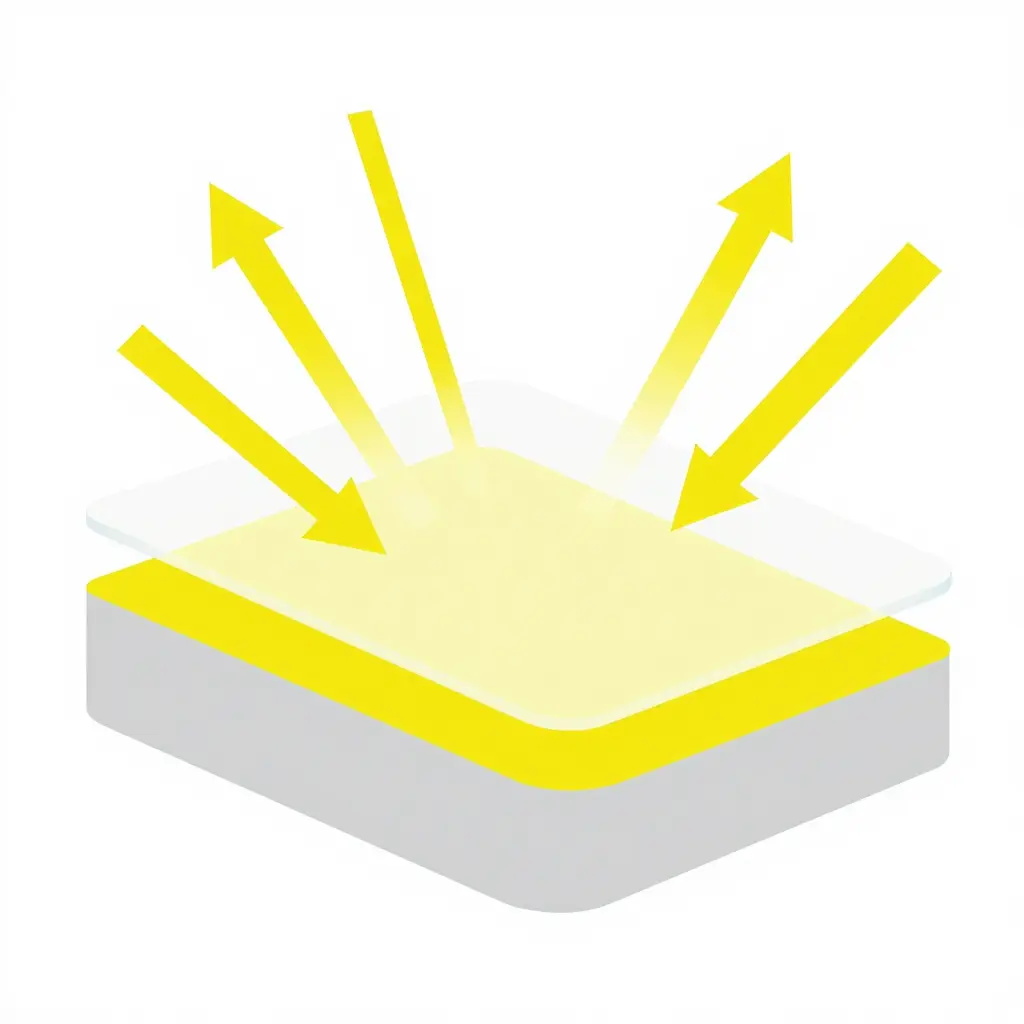
How the layers interact: UV radiation from the sun hits the decal at an angle. The clear overlaminate on top does most of the defensive work. Part of the incoming UV bounces straight back off its glossy surface, and the rest is absorbed and scattered before it can travel any deeper. That keeps the printed ink layer and the vinyl substrate beneath in the shade, away from the bleaching energy that kills color. Once that top layer burns through its UV blockers, nothing is left between the sun and your colors, which is exactly why decals fade in patches instead of all at once. Choosing a UV-resistant overlaminate before you reprint is the cheapest insurance you can buy for a fresh set of graphics.
FAQ: Overlaminate UV Resistance and Reprinting Dirt Bike Graphics
Why do dirt bike graphics fade unevenly after a season in the sun?
Uneven fading usually points to inconsistent UV blockers across the laminate film rather than “cheap ink” alone. Heat, mud, and repeated power-washing also degrade the clear coat in high-contact zones first. When a panel is stretched tightly over a curve, the overlaminate thins and its UV protection drops, so shrouds and number plates fade faster than flatter surfaces. Log these patterns before you reprint so the next job targets the real failure point.
How do I check overlaminate UV resistance before I reprint?
Ask for the laminate’s UV-blocking spec and accelerated weathering data, typically measured in hours of QUV or xenon-arc testing. Compare the carrier film, adhesive, and clear-coat chemistry, not just the product name. A practical check is to request a small printed sample with the exact laminate, then expose it to a week of direct sun and measure the color shift. That quick test stops you from repeating the same failure on the whole kit.
Do all overlaminates protect equally?
No. Cast PVC with high-grade UV inhibitors, polyurethane films, and textured matte laminates all behave very differently. A 1-mil economy laminate may block UV for only a single season, while a quality 3-5 mil cast overlaminate with true UV-stabilized chemistry holds color far longer. That gap matters most for custom dirt bike graphics, where pigment load and print density vary from panel to panel.
How long should UV-resistant overlaminates last?
A properly applied, quality UV-resistant overlaminate commonly holds visible color for 18-36 months of regular outdoor riding, and premium options can push beyond three years. Real lifespan depends on sun exposure, wash frequency, and how the bike is stored. Expect shorter intervals in desert or high-altitude climates with intense UV, and longer life for bikes kept under cover. Learn more about durable custom dirt bike graphics.
How can riders and print shops verify laminate batch quality?
Request the batch or lot number and a Certificate of Analysis from your supplier, and keep a color-target sample from every roll. Shops should log the laminate lot against each job so any fade complaint can be traced back to a specific run. Riders can compare early color shift against that reference sample instead of relying on memory. Consistent batch records are how you catch a weak production run before it ever reaches customers.
Does fading mean I need brand-new artwork, or just a smarter reprint?
Usually a reprint with a better overlaminate and a corrected color profile solves the problem. Only redesign the art if the fade is tied to specific dense colors or gradients that no film can fully hold. Fix the lamination and print workflow first, then judge whether the artwork itself needs updating.
Closing Takeaways
Uneven fading is not random. In nearly every case, it traces back to the overlaminate. The base print matters, but the clear protective layer carries the UV-blocking load. When its resistance is too low, sun-exposed panels fade while shaded panels stay rich. That contrast is the signature of a weak laminate, not a weak design.
Before you reprint, verify the UV specs. Confirm the overlaminate’s UV rating, its warranty window, and the test conditions behind both. Reprinting onto the same failing film simply restarts the clock on the same failure.
Choosing the right laminate is what protects custom dirt bike graphics over multiple seasons. A UV-stable, quality overlaminate keeps colors and edges crisp long after the first summer of sun.
Next steps:
- Inspect your graphics for uneven fading patterns across exposed versus shaded panels.
- Pull the UV spec sheet for the overlaminate currently on your bike.
- Compare UV ratings and warranty windows across laminate options.
- Select a UV-stable laminate matched to your riding conditions and sun exposure.
- Order customizable dirt bike graphics built on the proven laminate.
Fix the film, and you fix the fade.