
Riders notice it on the exhaust side first. After a handful of rides, the trailing edge of a dirt bike graphics kit lifts, curls, and starts trapping grit. That is not random damage; it is what repeated heat cycles do to vinyl.
A heat cycle is just the warm-up and cool-down the exhaust and nearby plastics go through on every ride. The panel expands, then contracts, ride after ride.
Cast and calendered vinyl respond to that cycle differently. Cast film holds its dimensions and stays tight around curves. Calendered film was stretched during manufacturing, and the stress left in it wants to relax; when it does, it shrinks and pulls away at the hottest edges.
That difference decides whether dirt bike graphics kits stay flat, so it is worth understanding before you buy.
Exhaust heat radiates onto the side panel, warming the plastic while the vinyl bonded to it absorbs the same energy. Plastic, film, and adhesive each expand at a different rate. Through each heating phase the film stretches a little; as it cools it contracts, but never quite back to where it started.
Those small differences accumulate over a season. The adhesive creeps outward from the center of the panel while the film’s memory pulls it back toward a flat sheet. The two forces meet at the edges. Each ride lifts the corner a bit more until it peels and curls over.
Cast film is poured rather than stretched, so it carries little internal stress and resists that deformation longer. Calendered film is squeezed through rollers, and the residual stress left in the sheet reactivates with heat, speeding up edge lift. Kits built from quality cast film and a heat-resistant adhesive are the simplest way to slow the process.
Cast vs. Calendered Film: What Changes at the Material Level
The two films differ in how the vinyl is made. Cast film starts as liquid resin poured onto a moving liner, where it flows out and cures into a thin, uniform sheet. Nothing stretches or pulls the resin, so the finished film carries almost no internal stress; that is what gives it dimensional stability and low memory. Calendered film is pressed from heated resin through a series of rollers, which produces a thicker sheet but stretches the polymer chains and locks in stress. The film keeps a strong memory of its original flat shape.
That stored stress is what heat releases. Warm a calendered film with exhaust or sun and it tries to return to the flat sheet it came from, shrinking back and lifting at the corners. Cast film has no built-in tension to recover, so it resists both shrinkage and edge curl.
The difference shows up most on high-heat panels like the exhaust side. For riders ordering custom dirt bike graphics, the practical point is that kits built on cast film hold their shape better than calendered versions through repeated heat cycles.
The two films separate most clearly on heat, memory, and where each can be safely mounted on a dirt bike graphics kit.
| Film Type | Manufacturing Method | Film Thickness | Dimensional Stability | Memory and Shrinkage | Best Use for Dirt Bike Graphics |
|---|---|---|---|---|---|
| Cast Film | Liquid PVC organosol poured onto a smooth casting liner, then cured (no mechanical stretching) | 2-4 mil (50-100 microns) | Excellent – near-zero internal stress, so it stays put across heat cycles | Low memory; minimal shrink (typically under 1%) at exhaust-side temperatures | Complex curves, vents, and exhaust-side panels that see repeated heat cycles |
| Calendered Film | Solid PVC resin pressed through heated rollers, then stretched to final gauge | 3-6 mil (75-150 microns) | Moderate – higher internal stress that can release and lift under heat | High memory; can shrink 3-5% when hot, pulling edges back and curling | Flat or gently curved panels and budget kits used away from high-heat zones |
Why the Exhaust Side Panel Is the Stress Point
No other panel on a dirt bike sees the same combination of heat, poor airflow, and curvature, which is why the vinyl there fails first. Three things converge at that spot.
Concentrated radiant heat. The exhaust pipe and muffler radiate heat onto the adjacent plastic and push surface temperatures well above ambient. That softens the adhesive and relaxes the film’s built-in memory.
Little airflow at low speed. In technical sections, at idle, or on slow trails, almost nothing cools the panel. Heat builds and lingers, holding the film in its most pliable state.
Edges close to the pipe. The outer edge of the panel sits nearest the exhaust. It absorbs the most direct heat and loses grip first.
The panel’s convex curve adds peel stress of its own. The film has to resist bending around it, and any lifted edge becomes a lever that peels a little further each cycle. That is why edge lift and curling are specific to the exhaust side. Selecting durable dirt bike graphic kits made from cast film reduces the risk, but installation technique still matters.
Reading the Diagram
The internal structure of the two vinyl constructions used in dirt bike graphic kits explains the difference. A cast film is a uniform, stress-free sheet bonded to the panel with an even adhesive layer. A calendered film shows its characteristic molecular grain, with arrows marking the directional stress locked into the material during manufacturing. That stored stress is what eventually curls a panel after enough heat cycles.
Cast film flows onto a casting sheet instead of being squeezed through rollers, so its molecules stay relaxed and can expand and contract in every direction. Calendered film is pressed between rollers, which aligns the polymer chains in one dominant direction and bakes in tension. When exhaust heat makes the film expand, the only way to relieve that tension is to lift, shrink, or curl at the edges.
If you want options that resist this heat-driven failure, look for custom dirt bike graphics that specify cast film construction for high-temperature zones.
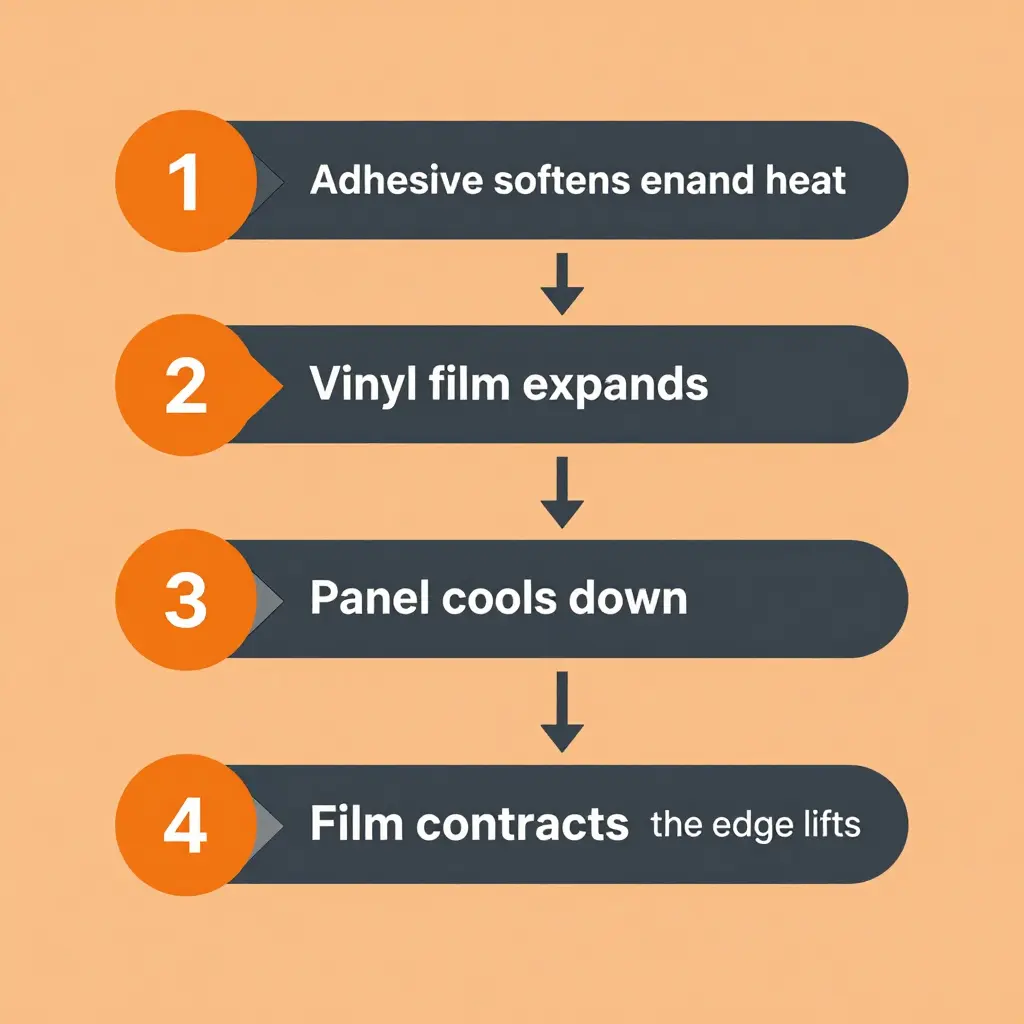
Why Heat Turns Into a Lifted Edge
As the panel heats up, the adhesive softens while the vinyl expands. On the way back down, the film contracts faster than the adhesive can re-bond, so the edge pulls away from the plastic. This is a mechanical failure, not an adhesive one: the bond simply cannot keep pace with the film’s movement.
Soften, expand, cool, contract. Every heat cycle repeats the sequence and leaves a slightly larger lift at the exhaust-side edge.
Cast Film vs. Calendered Film
Cast film is poured as liquid resin onto a belt and carries almost no built-in stress. It shrinks little and recovers well across many heat cycles.
Calendered film is squeezed through rollers, which locks stress into the sheet. Heat releases it, so the material moves more and lifts sooner on the same panel. Cast film tolerates the cycle better because its low internal stress keeps the edge stable, which is why it anchors most dirt bike graphics kits built for hot exhaust routing.
Edge Lift Over Successive Heat Cycles
[Line chart: X-axis = Heat Cycles (0, 5, 10, 20, 40); Y-axis = Edge Lift (mm), 0-3. Two plotted series: “Cast Film” runs low and nearly flat (0.1, 0.1, 0.2, 0.2, 0.3 mm) while “Calendered Film” climbs steadily (0.2, 0.5, 0.9, 1.6, 2.8 mm). Legend distinguishes the two lines.]
Caption: Cast film stays low and flat while calendered film rises steadily, illustrating why cast film maintains adhesion longer under exhaust heat.
Installation and Maintenance Practices That Maximize Vinyl Durability
How well a kit survives heat cycles comes down to installation. Wash the plastics with isopropyl alcohol, strip any wax or silicone residue, and let every panel dry completely. Contaminants keep the adhesive from making full contact, and lifting starts sooner once the exhaust warms the plastic.
Press the decal down firmly and evenly, then work a squeegee from the center outward to push trapped air toward the edges. Air pockets become expansion zones once radiant heat builds behind the panel.
Post-heat the edges with a heat gun to roughly 90-100 C and press them down. This activates the adhesive and helps the film conform to tight curves. Check the exhaust side edges monthly, and reseal a lifted corner before it spreads.
Cast film cuts down on maintenance because it resists shrinkage and holds its shape far longer than calendered vinyl. For durable options, compare custom graphics for dirt bikes made from cast film.
FAQ: Dirt Bike Graphics and Heat Cycles
Why do dirt bike graphics kits curl at the exhaust side panel?
The exhaust side panel absorbs radiant heat from the muffler and header, and repeated heat cycles expand the vinyl faster than the adhesive can hold it. That stress concentrates at the panel edges, where the film lifts and curls outward. It is a mechanical failure, not a cosmetic one.
Do cast and calendered film really react differently to heat?
Yes. Cast film is poured as a liquid, so its molecules stay relaxed and it shrinks very little when heated. Calendered film is pressed from heated rollers, and the stress left in it makes the film shrink and lift sooner at hot edges.
Can curled graphics be re-adhered?
Sometimes, if the adhesive and film are still intact. Clean the panel with isopropyl alcohol, warm the vinyl gently, and press it back down with a squeegee. Once the adhesive is contaminated or the film has stretched permanently, replacement is the reliable fix.
Which film type lasts longer on heat-exposed panels?
Cast film outlasts calendered film near the exhaust, because its low-shrink construction resists lifting and edge curl through repeated heat cycles. For a durable dirt bike graphic kit, choose cast film with a strong, heat-resistant adhesive.
Conclusion: Match Your Film to Your Heat
Repeated heat cycles lift the edge of a graphics kit, and cast film handles that stress better than calendered film, which makes it the safer choice for exhaust-exposed panels. Calendered vinyl is fine on cooler plastics; it just cannot match cast film’s dimensional stability as temperatures climb.
The practical steps to prevent curling: clean and degrease the surface, apply with controlled heat and pressure, seal exposed edges, and give the adhesive 24 to 48 hours to cure. Then match film to heat exposure – cast near the exhaust, calendered elsewhere if you prefer.
Whether you are shopping for best dirt bike graphics or installing dirt bike graphics kits, choose film that suits your riding conditions. Motograpics makes fade-resistant, durable vinyl for motorcycle enthusiasts.