
Pre-Made versus Custom Dirt Bike Graphics: Defining the Two Buying Routes
A pre-made dirt bike graphics kit is a design that already exists in a supplier’s catalog: fixed colorways, drawn for specific models, held in stock or reprinted on demand. Nothing is commissioned, so the buyer’s decision comes down to what is available, what it costs, and how fast it ships.
Custom work runs the other way. Artwork is drawn or adapted to one bike, brand or livery brief, then printed to that specification in the quantity ordered.
Commercially, these are two supply models rather than two products. Stock trades flexibility for predictability; custom trades predictability for control over the design and who else can buy it. Plenty of suppliers sell both, so the useful question is not which is better but where a given order sits between them.
This comparison uses three factors a buyer can quote, track and check against invoices: lead time, cost per panel, and artwork reuse. Two kinds of number appear below, and they are not interchangeable. List prices and processing windows come from the catalog and its published shipping policy. Cost-per-panel figures come from a build-up model, with assumptions stated wherever they apply.
Those three factors matter most to anyone restocking or scaling a graphics offer. Lead time sets reorder cycles and the risk of a model sitting unsold because its kit is out of stock. Cost per panel sets the margin on each set sold. Artwork reuse decides whether one design can carry across several models and repeat orders without paying twice for design work. A catalog such as this pre-made KTM graphics range shows how fixed designs are listed by model and colorway, which is the easiest way to benchmark the two routes side by side.
Lead Time Comparison: Pre-Made vs Custom Dirt Bike Graphics
Every order walks the same production line. The fork in the road is at the front, where design and approval happen.
With pre-made dirt bike graphics, the artwork already exists as a proven template, so approval means choosing a design and confirming the model at checkout. The item is a stock SKU, and processing is quoted at one to three business days. Custom work moves to a different rhythm: you brief the design, receive a proof, ask for changes, and repeat until the layout is signed off. That loop is where the days go, especially when several people have to weigh in.
Artwork preparation then splits again. Pre-made files are print-ready, already nested and color-separated. Custom files have to be built, scaled to your exact plastics, and checked for bleed and panel alignment, which is a day’s work or more.
Print scheduling, vinyl cutting and lamination run through the same shop queue either way, though custom orders often need a dedicated print run instead of a slot in an existing batch. Trimming, wrapping, boxing and handover to the carrier take the same time regardless, and shipping adds the same transit days to both.
Three things move the clock whichever route you choose: order volume, because large multi-bike orders add production days; stock status, since popular films and laminates go on backorder; and seasonal queue pressure, which stretches standard processing windows before and during race season.
- Pre-made designs: checkout goes straight to production, one to three business days to dispatch.
- Custom designs: add three to five business days for made-to-order production, on top of standard processing, and more if the proof takes several rounds.
- Both routes: cutting, lamination, packing and shipping run on the same timelines.
- Wildcards: order volume, film availability and seasonal queue pressure.
The gap sits at the front of the line, not the back. A stock kit leaves in one to three business days; bespoke work lands nearer two weeks from order to dispatch once proofing is counted. Nothing later in the process can recover that time.
Pre-Made vs Custom Dirt Bike Graphics at a Glance
| Comparison Factor | Pre-Made Graphics | Custom Graphics |
|---|---|---|
| Lead time | 1-3 business days to dispatch, ships from stock | 4-8 business days of processing once proofing is added |
| Cost per panel (basis stated) | About $18-$25 across a $199-$248 kit, at retail | Quoted per job; modelled shop cost of $27.60 on a 12-panel first run |
| Minimum order quantity | 1 kit, no minimum listed | Set by the studio; agree it before the design fee is quoted |
| Artwork reuse rights | Licensed for the bike it is bought for, no reprint rights | Set by contract: file handover, copyright transfer or limited license |
| Revision cycles | None, the artwork is fixed | Proof rounds per the studio’s agreement, not a default number |
| Design exclusivity | Shared catalog design, resold freely | Optional and priced as a separate clause, usually time and region bound |
| Scalability for repeat orders | Reorder the identical SKU while stock lasts | Reprint from retained files at standard processing time, or rebuild if the files stayed with the studio |
Three differences decide most orders: dispatch measured in days versus a couple of weeks, a design fee that adds roughly $20 to every panel on a first run, and permanent rights to the artwork. What each of those costs a business over a season is worth working through.
Cost Per Panel Breakdown: Where the Money Actually Goes
Strip the branding away and every panel in a kit is built from the same six inputs. What separates pre-made from custom dirt bike graphics is not the materials list but how those inputs behave as the order grows.
The six cost components, line by line
| Cost component | Pre-made ($/panel) | Custom, first run ($/panel) | Custom, repeat run ($/panel) |
|---|---|---|---|
| Vinyl substrate | 1.10 | 1.55 | 1.55 |
| Ink and printing | 2.40 | 2.85 | 2.85 |
| Lamination | 0.85 | 1.10 | 1.10 |
| Cutting and weeding | 1.15 | 1.30 | 1.30 |
| Artwork preparation labor | 0.00 | 20.00 | 0.00 |
| Packaging | 0.70 | 0.80 | 0.80 |
| Cost per panel | 6.20 | 27.60 | 7.60 |
Custom figures model a twelve-panel first run with a $240 design fee; the artwork line is the fee divided by twelve. Every column assumes the same panel layout.
Keep the basis straight. These are shop costs, before margin and before shipping. A pre-made kit lists at $199-$248, which on a ten- to twelve-panel kit works out to roughly $18-$25 per panel. The gap between $6.20 and that retail figure is margin, not a second version of the same number.
Why pre-made pricing barely moves
A pre-made kit is a design that has been drawn, proofed and cut hundreds of times. The artwork labor was absorbed long ago, so the supplier quotes a stable cost per panel with no design line at all: you pay for vinyl, ink, laminate, cutting and a bag. The trade-off is that you ride whatever sits in the catalog, a sensible call when you need a fast refresh across a fleet of bikes. The pre-made KTM graphics range shows how deep that off-the-shelf choice runs.
Why custom front-loads the artwork
Custom work moves the design fee to the front of the order. Someone has to build the template, place your sponsor logos, color-match the plastics and proof it, and that bill is the same whether you print 8 panels or 80. The arithmetic is simple: cost per panel = variable panel cost + (artwork fee ÷ panels in the run). On a twelve-panel run a $240 fee adds $20.00 to every panel. On a 120-panel run the same fee adds $2.00. Nothing about the vinyl got cheaper; the fixed cost simply has more panels to spread across.
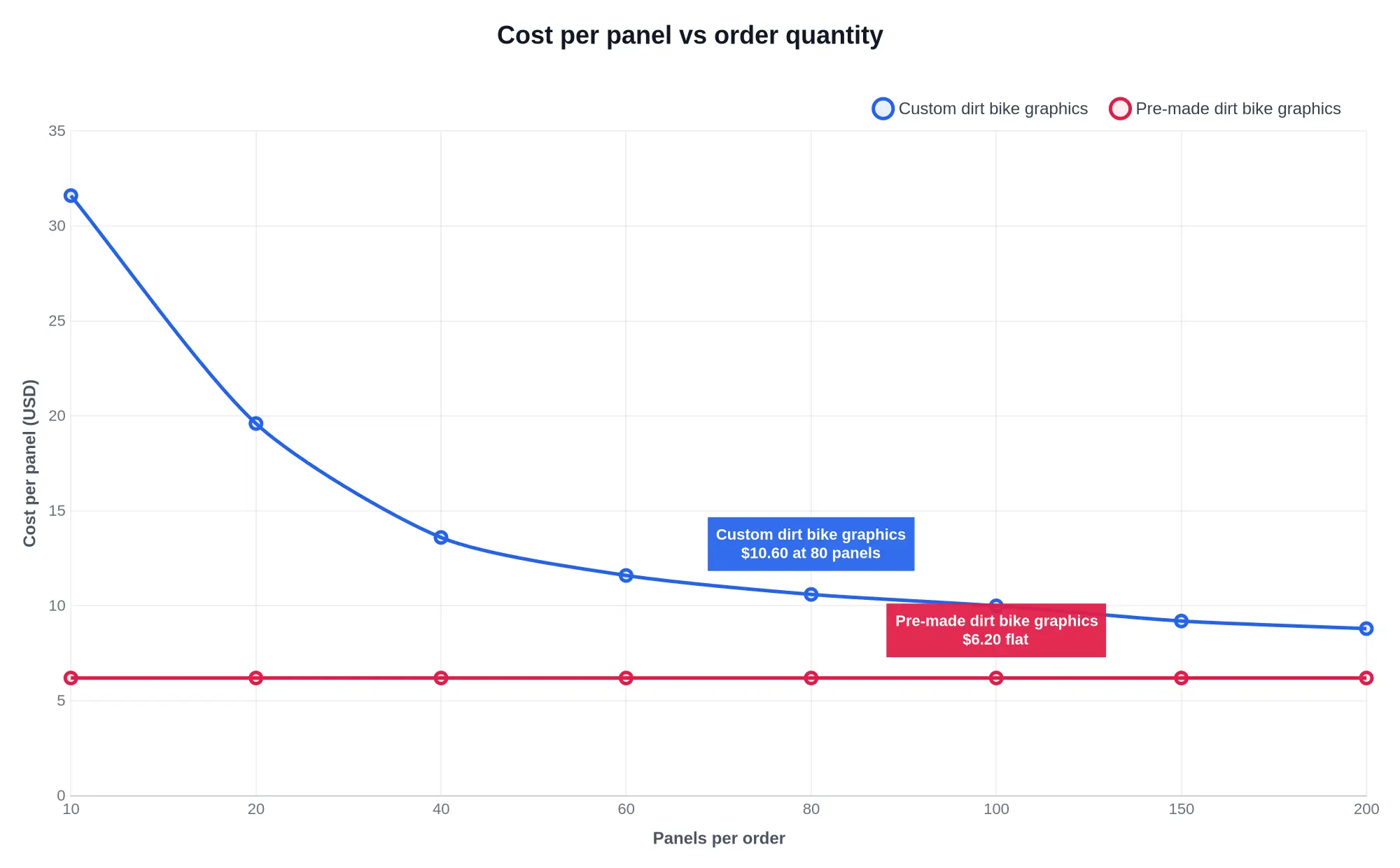
Design amortization and repeat orders
This is where custom dirt bike graphics change character on the second order. The artwork is yours, proofed and on file, so a repeat run carries no design fee and the cost per panel drops from $27.60 to $7.60, within about a dollar and a half of the pre-made figure. It does not fall below it. Under this model custom never undercuts stock on panel cost; it converges toward it as the run lengthens. That is the reason to plan a season of livery changes in runs rather than single kits, because every reprint spreads the original design fee across more panels until it stops mattering.
Bottom line: pre-made wins the first order on price and simplicity. A custom design plus deliberate reprints closes the gap to roughly a dollar and a half per panel and buys exclusivity, but it stays above the stock panel cost, so the case for custom rests on what the design is worth rather than on unit cost.
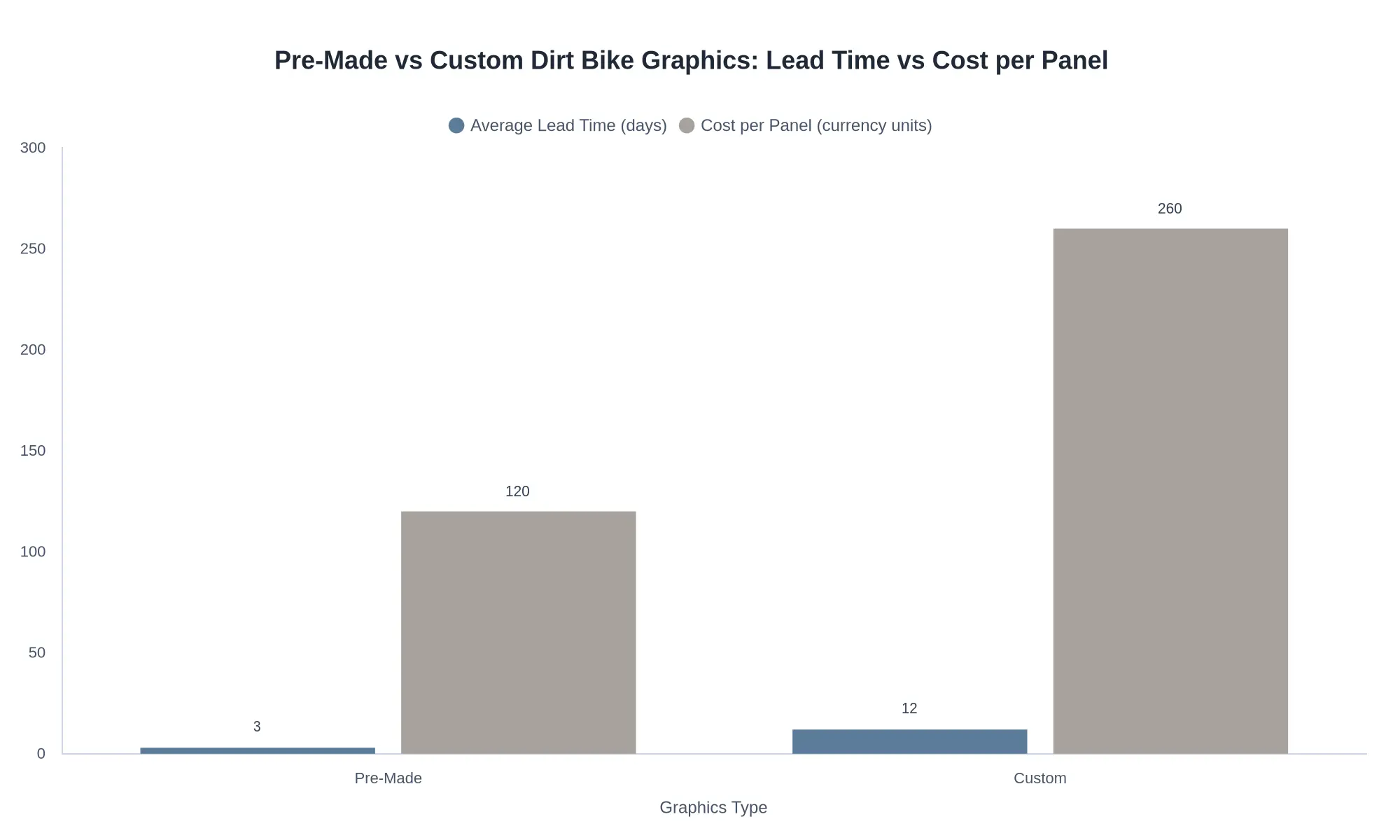
Figure: stock kits leave the shop in about three days; bespoke work runs closer to twelve days from order to dispatch, and its first-run panel cost is several times the stock figure.
Artwork Reuse and Licensing: Who Owns What, and Why It Matters
Most buyers stop the conversation at colors and fit. The quieter question, and the one that decides long-term value, is who holds the rights to a design once the invoice is paid. Artwork reuse is the practical answer: permission to print an existing file again, on a fresh set of vinyl decals, in a later season, or on a different machine, without starting over in a design program. Reuse is a right, not a file format, and it lives in the terms of sale rather than in the artwork.
Pre-made designs: a licensed copy, not a handover
When a shop sells a pre-made kit, the buyer gets a license to print and apply that design, usually on a single bike. The seller keeps ownership and can sell the same artwork to anyone. Reorders are effortless because the production file already sits in the seller’s archive with panel outlines, bleed and color settings intact. The trade-off is zero exclusivity: identical graphics can appear on another rider’s machine in the same class.
Custom dirt bike graphics: commissioning an original file
With custom dirt bike graphics, a designer builds artwork for one buyer. What that buyer actually receives depends entirely on the contract: layered source files, a full transfer of copyright, or a limited license to reproduce for personal use only. Many buyers assume commissioning equals ownership, but those are two separate transactions. Ownership of the visual concept, ownership of the production file, and the right to reprint are each negotiable.
Ownership, storage, and print-ready artwork
Three questions settle the ownership half of the contract. Who keeps the layered source file? Who stores a print-ready version with correct bleed, panel templates and color profile? Who is allowed to send that file to a printer? Archiving matters more than buyers expect, because a design with no retained production file has to be rebuilt from scratch, and rebuilt artwork rarely matches the original exactly.
Exclusivity clauses and cross-model reproduction
An exclusivity clause is what stops a studio reselling the same artwork to another rider in a defined region, series or time window. It is a separate line item with its own price, and it is never automatic. Scope matters just as much: a license should state whether the design may be adapted to other bike models or partial panel sets. Refitting a design means re-cutting templates and rebalancing proportions and logo placement, which is real work. Some studios keep model-specific graphics families, so adaptation is quick, while others treat each new platform as a fresh project. See how one design translates across a model range in these KTM graphics collections.
How reuse rights drive long-term value
| Question | Pre-made (licensed copy) | Custom (commissioned file) |
|---|---|---|
| Who owns the artwork | Seller | Buyer or studio, per contract |
| Reuse rights | Unlimited for the seller | Defined by license scope |
| Exclusivity | None | Optional, time and region bound |
| Reorder process | Reprint from archive | Reprint or rebuild, depending on file handover |
| Other models or panel sets | Often adapted across a range | Requires template rework |
| Effect on resale | Design not unique, limited claim | Documented originality supports asking price |
Three outcomes follow from those terms. Resale: a machine wearing a one-off design with documented rights is easier to market and defends its price, while a pre-made wrap makes no uniqueness claim. Brand consistency: a team that owns its file can reprint identical decals race after race and across a fleet, keeping sponsors’ logos in the same position every time. Relaunch cost: rebuilding artwork for a later season means design hours, approval rounds and new proofing, whereas a retained print-ready file relaunches at little more than the cost of printing.
The kit price is paid once. Reuse rights decide how many times that price keeps working.
Before locking artwork in for a second or third production run, run this due-diligence check.
- File format and resolution – confirm print-ready vector or 300 DPI files, because a low-res JPEG falls apart the moment it stretches across a full panel set.
- Ownership and licensing – verify in writing whether you own the design outright or only hold a limited license tied to one supplier.
- Source file access – ask whether the layered working file stays retrievable for future reorders or leaves with the original designer.
- Permitted scope of use – check whether the artwork is cleared for a single model or can carry across several panel sets, as with our KTM graphics range.
- Storage and retrieval – decide where archived artwork lives, who can reach it, and how fast it can be pulled when a repeat order lands.
- Refresh cycle impact – designs date, so build a realistic shelf life into the reuse plan before the look starts feeling stale.
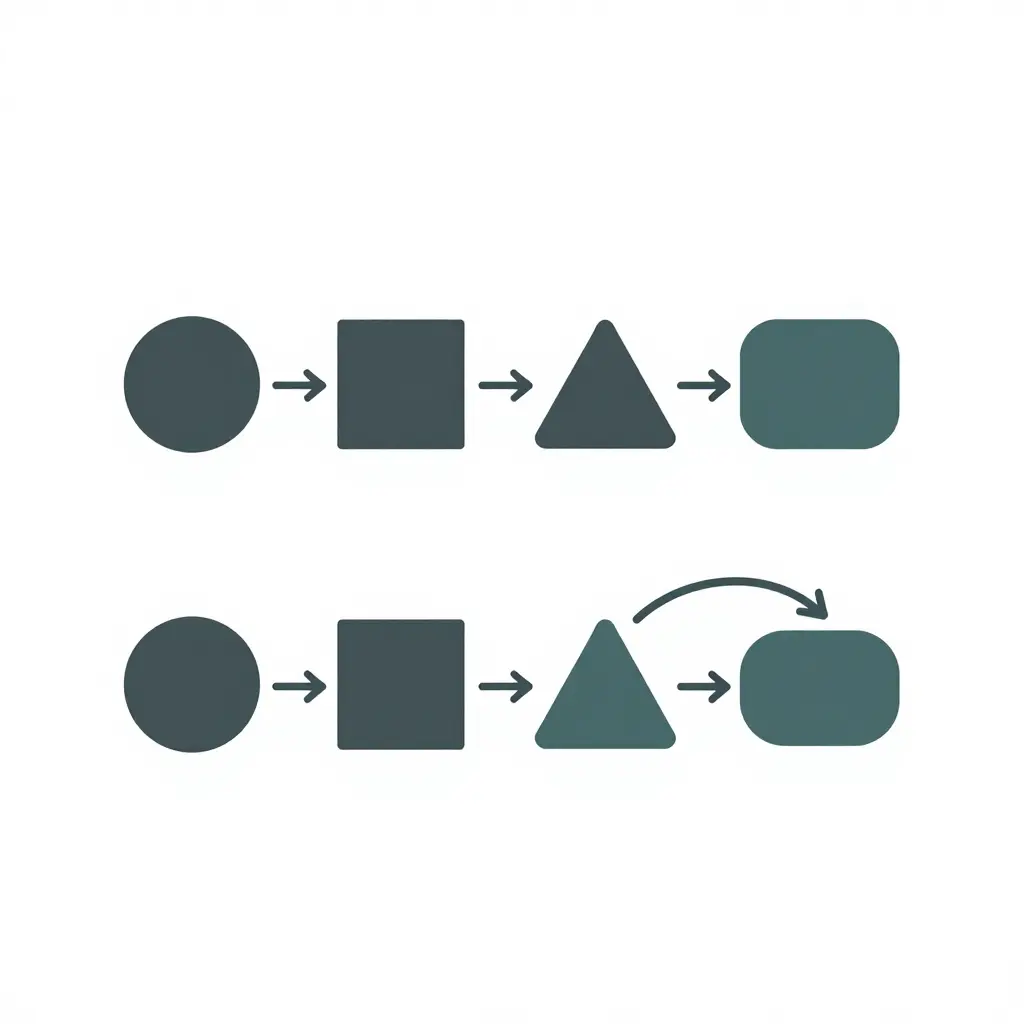
How to read it: the short chain on top is the pre-made route, where the artwork already exists so shapes move in one direction only. The longer chain below adds steps plus a loop-back arrow, the visual shorthand for a proof-and-revise cycle. That single loop accounts for most of the extra lead time in a custom build.
A Decision Framework for Choosing Between Pre-Made and Custom Dirt Bike Graphics
The right answer depends less on personal taste than on how your orders, timelines and team actually operate. Work through these four steps in order.
- Measure your order volume per bike platform. If you move dozens of kits a month across a handful of popular models, pre-made dirt bike graphics spread artwork and setup costs across enough panels to keep the cost per panel low, whereas one-off or very small runs rarely justify a custom design fee.
- Fix your required speed to market. Pre-made kits ship from stock and fit launch dates, race weekends and restock cycles measured in days. Custom work adds design rounds, revisions and proofing, so it only pays off when the timeline can absorb a couple of weeks.
- Decide how much differentiation your brand actually needs. Where a stock look is acceptable to your customers, ready-made kits free up budget and working capital. Where your shop name, sponsor logos or a signature colorway is the reason people buy from you, custom work is the only way to get artwork nobody else can stock.
- Audit your internal design capability and artwork reuse potential. With no in-house designer, pre-made graphics remove the skill gap entirely. If you already own print-ready vector files and design hours, custom work lets you reuse one set of artwork across multiple panels and models to dilute the effort per unit.
Many owners never need to pick a side. A mixed strategy works: hold pre-made inventory for your highest-volume, fastest-turn platforms so stock orders and walk-in customers are never delayed, and reserve custom work for flagship builds, race teams and wholesale accounts where differentiation carries commercial weight. Before commissioning anything new, check how deep the existing range runs for your best-selling platforms, such as the KTM graphics catalog. Catalog breadth you can buy today is usually cheaper than artwork you have to create. Review the mix each quarter against actual lead times and sell-through, and adjust where the numbers point rather than where habit does.
Where the Money Actually Sits: Cost Allocation per Panel
When a bespoke quote lands high, the reason is in the build-up. Only one of the six lines moves as the order grows, and it is the one buyers rarely ask about. The chart below shows the split for a first run.
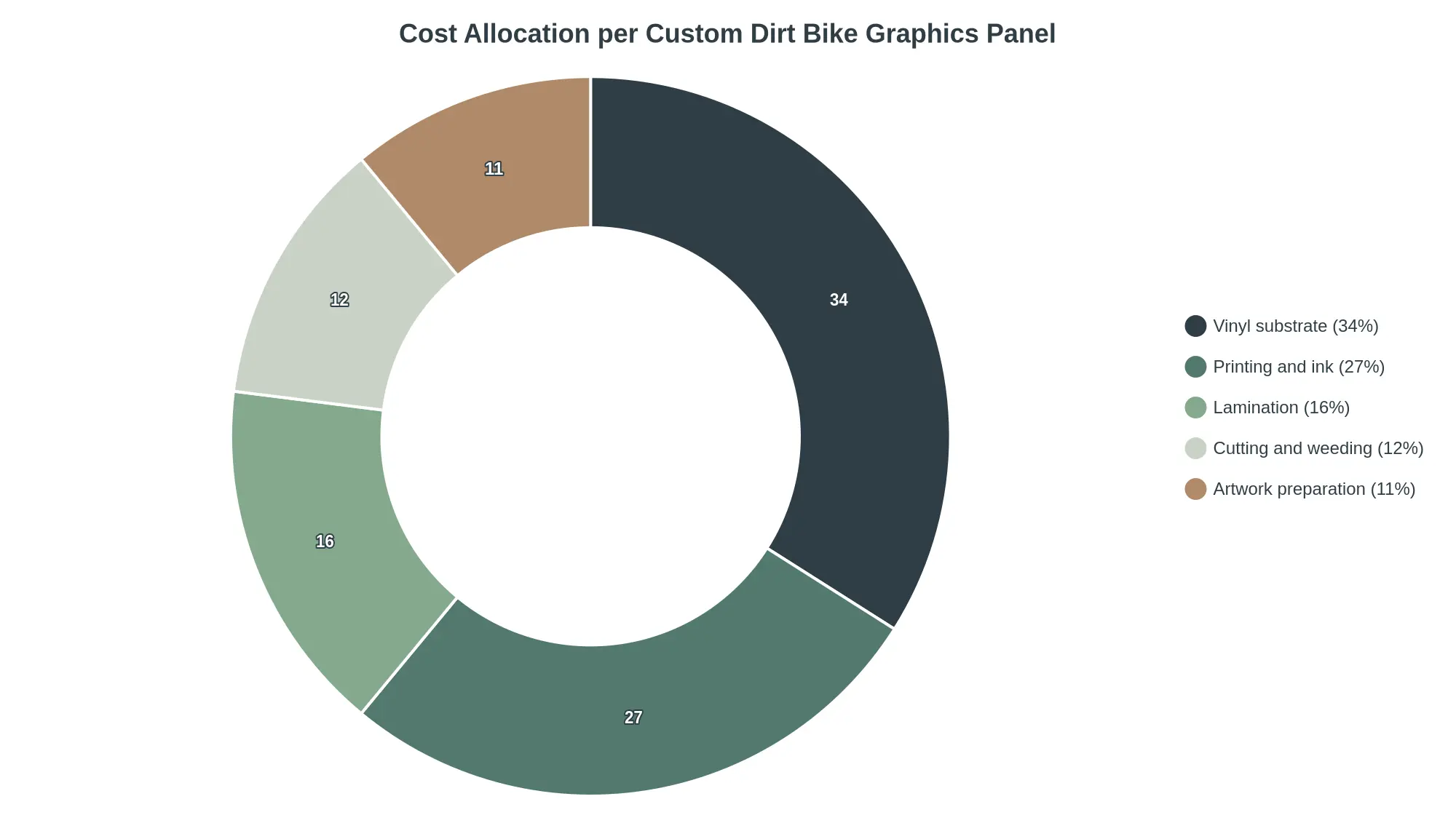
Artwork preparation is the only slice that shrinks with volume. The chart shows the shape of the split; the table below gives the shares from this article’s build-up, and those are the numbers used for the arithmetic.
Reading the Slices
| Cost component | Share of a first-run panel | Share of a reprint panel | What happens as order volume rises |
|---|---|---|---|
| Artwork preparation | 72.5% | 0% | Collapses per unit once the file is print-ready |
| Printing and ink | 10.3% | 37.5% | Drops slightly with better nesting and longer runs |
| Vinyl substrate | 5.6% | 20.4% | Stays close to flat; material is bought by the meter |
| Cutting and weeding | 4.7% | 17.1% | Small savings from fewer setups per batch |
| Lamination | 4.0% | 14.5% | Effectively flat once the machine is running |
| Packaging | 2.9% | 10.5% | Flat |
A first run puts nearly three-quarters of the panel cost into artwork. A reprint puts none of it there, which is why the same kit can be quoted twice at prices that look unrelated.
For a Chart.js implementation, the dataset is a doughnut with cutout: "58%", six labels matching the table above, values of [72, 10, 6, 5, 4, 3] (they sum to 100), and a six-tone palette running from deep slate through sage to warm clay. No gradients, no shadows, no 3D depth.
labels:  Artwork preparation (72%), Printing and ink (10%), Vinyl substrate (6%),
         Cutting and weeding (5%), Lamination (4%), Packaging (3%)
data:    [72, 10, 6, 5, 4, 3]
colors:  #2F3E46, #52796F, #84A98C, #CAD2C5, #B08968, #D9C5B2
How to Use This in Your Buying Decision
- One kit, ten panels? Artwork is about 72% of what that panel costs, so a first run lands near $31.60 against $6.20 for stock. Buy stock.
- Five kits, fifty panels? The design fee thins to $4.80 a panel and the total sits at $12.40 against $6.20. Double, not quadruple, and you get artwork nobody else has. If you want the stock number instead, browse pre-made graphics kits by model and skip the design line entirely.
- Ten kits, a hundred panels? The design fee adds $2.40, so the panel costs $10.00 against $6.20. The question is no longer cost but whether consistent fleet livery is worth about $3.80 a panel.
Compare the two routes at the same order quantity, then ask which line drives the gap. It is nearly always design labor, and it is the only line that goes away on the second order.
Mapping Pre-Made and Custom Graphics onto the Real Catalog
How the two options behave on lead time and cost is one thing. Where each one sits inside a catalog decides whether it fits your business. The pre-made side is organized by bike platform, so a shop or a rider can pull a finished set for a specific model without a design conversation. Custom work starts from the same platform list, except the artwork is built for a single order.
The pre-made ranges, platform by platform
The ready-to-order collections follow the bikes themselves, which keeps quoting and cross-referencing straightforward.
For light electric models, the 79Bike graphics collection ships as complete, model-specific sets with panel fit and decal count settled before you order.
Owners of the eRide platform get a similar structure: eRide graphics are grouped by model, so shroud and fender shapes are matched in advance.
The Arctic Leopard graphics range does the same for that chassis, so there is no artwork approval stage to schedule.
The ReRode R1 graphics cover fairing and side panels as one kit rather than as separate pieces to assemble.
On the performance side, Stark Varg MX and EX graphics are laid out around the full-size bodywork, the closest pre-made equivalent to a custom full wrap.
KTM graphics serve as the motocross reference point, built around the usual shroud, fender and airbox panels.
Surron listings split three ways: Surron Light Bee graphics for the smaller chassis, Surron Ultra Bee graphics for the mid-size bodywork, and Surron Hyper Bee graphics for the larger platform.
Talaria splits four ways, with separate collections for Talaria XXX, Talaria MX3 and MX4, Talaria MX5 and Talaria Komodo graphics.
Where custom work branches off
Each of those collections is a starting point, not a ceiling. A custom order can borrow the panel template from any platform above and then change the colors, the number plates, the sponsor marks and the layout. That is why the catalog comparison matters: if your bike already has a dedicated collection, the pre-made route removes the design stage. If it does not, or the livery has to carry a dealer’s own identity, the custom route reuses the same templates with new artwork attached.
| Platform group | Pre-made collection | Typical starting point for custom work |
|---|---|---|
| Light electric (79Bike, eRide, Arctic Leopard, ReRode R1) | Fixed kit per model | Recolored or restructured template |
| Performance electric (Stark Varg MX and EX, Surron Light Bee, Ultra Bee, Hyper Bee) | Fixed kit per model | Full artwork build on existing panels |
| Talaria range (XXX, MX3 and MX4, MX5, Komodo) | Fixed kit per model | Full artwork build on existing panels |
| Motocross (KTM) | Fixed kit per model | Sponsor-led layout, model-specific |
One quality point that applies to both
Both routes rely on UV-resistant vinyl decals, and that is the detail worth holding onto when you compare prices. Print method, laminate and cutting process are shared across the pre-made collections and the custom builds, so the gap between them sits in artwork and setup time, not in how long the graphics survive sun and washing. Compare materials like for like before you compare totals.
For a shop or a fleet buyer, the practical split is simple: stock the collections that match the bikes you already service, and reserve custom orders for livery work that has to be specific to your business.
Visual Summary: Which Path Fits Your Build?
The whole decision fits in one diagram.
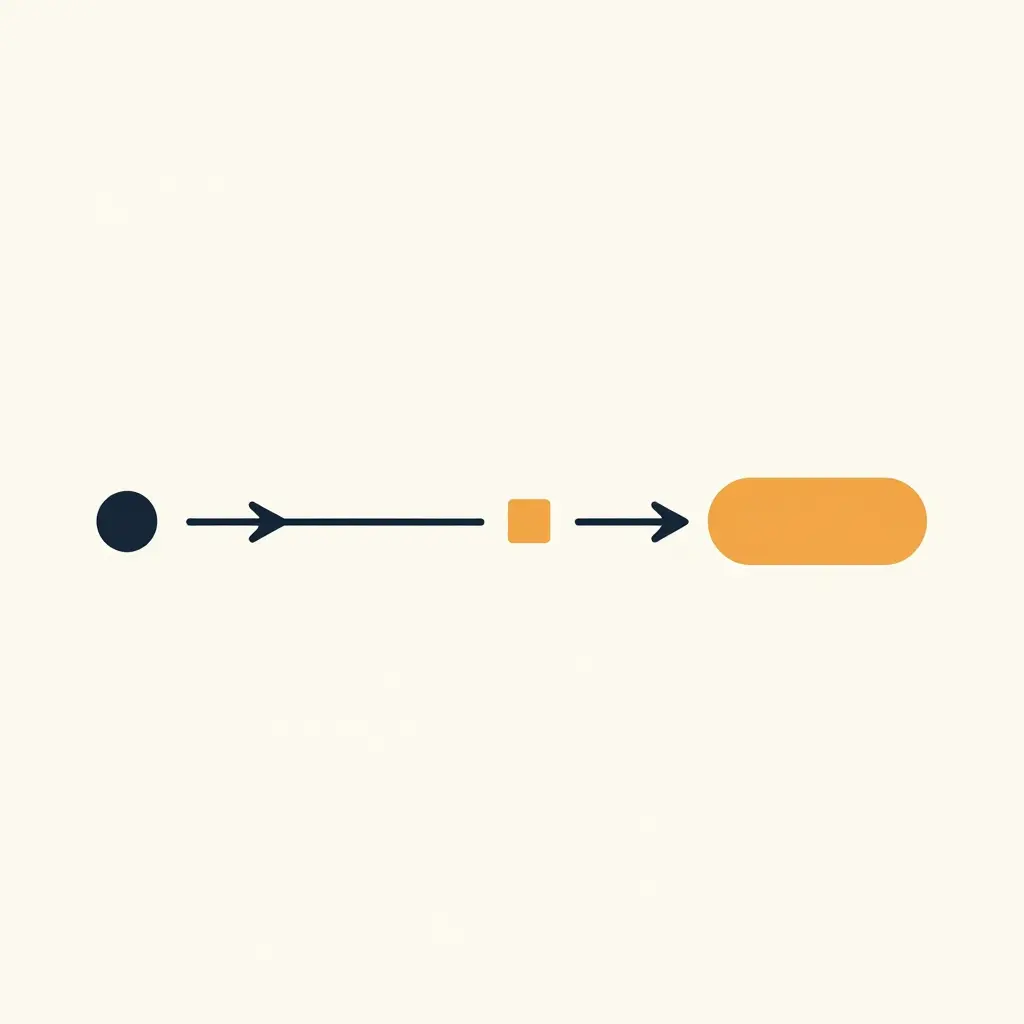
How to read it (left to right):
- Start shape (far left) – your bike, your budget and your go-live date, all in one place.
- Short upper path – the pre-made route: fewer steps, faster to ship, artwork already locked and reused across many panels.
- Longer lower path – the custom route. One extra approval-and-artwork node sits in the middle, and that node is where the lead time and the extra per-panel cost are added.
- Converging point (far right) – the same outcome either way: a fully wrapped, race-ready bike.
The drawing uses only two colors so nothing competes with the logic: charcoal for structure, orange for the longer path that asks more of your calendar. If the short path is the better fit, start from an existing kit in the KTM graphics range and skip the artwork node entirely.
Design spec for reproduction: two-color palette (charcoal #1F2933, orange #F97316) on off-white, uniform thin line weight, simple circles/squares/rounded rectangle plus arrows, generous white space, wide horizontal layout, no text inside the artwork.
Frequently Asked Questions
How much longer does a custom dirt bike graphics order usually take than a pre-made order?
Pre-made kits print from files that already exist, so production starts the same or next business day and dispatches within one to three business days. A custom order adds a design and proofing stage before anything goes to print: three to five business days of extra processing, which puts the order-to-dispatch window around four to eight business days. Allow another day or two for each revision round that runs past the first proof.
Why is cost per panel typically higher for custom graphics at low volumes?
Design work, proofing, color matching and press calibration are fixed setup costs, divided across however many panels are in the run. On a twelve-panel first run with a $240 design fee, artwork alone adds $20 to every panel and takes the shop cost to $27.60 against $6.20 for a stock panel. Run the same design over 120 panels and the fee adds $2.00, bringing the panel to $9.60. The gap narrows with volume but does not close, because the stock panel never carried a design line in the first place.
Who owns the artwork when custom graphics are commissioned?
Ownership is set by the written order agreement rather than by default. A common arrangement gives the client a license to use the finished design on their own bikes while the studio keeps the working files, which limits reuse by either side. If full transfer is included in the price, the studio is normally barred from reselling the design to other customers. Confirm the terms before production starts.
Can pre-made designs be reused across multiple bike models?
Pre-made designs are cut for one model’s specific plastic shapes, so a kit made for one bike rarely transfers to another without adjustment. Many studios keep template libraries that allow the same design to be re-cut for a second model, but that is produced as a new file set rather than a straight repeat of the original. Shops can compare model-specific pre-made graphics before assuming a design is portable across a range.
Which option suits a business that reorders the same design every season?
Pre-made is usually the better fit for repeat seasonal orders. Once the files exist, every reorder skips design and proofing, lead time drops back to standard production, and cost per panel stays at the stock rate. Custom work is worth the additional setup only when the design has to stay exclusive to your business, and it pays off fastest when you own the files and reprint them yourself rather than paying for a rebuild each season.
The Bottom Line: Matching Each Option to Your Business Priorities
Across all three dimensions the trade-off holds. Lead time favors pre-made graphics, which dispatch in days rather than weeks, while custom work builds design and proofing into every order. Cost per panel also favors pre-made, because shared artwork and volume keep unit pricing low, whereas a custom first run carries a design fee of roughly $20 per panel that only thins out over longer runs. Artwork reuse is the dimension that favors custom: a bespoke design owned by your business can be repeated across later builds without a new design fee, provided you keep the files and specifications on hand. Many shops settle this by stocking a few pre-made designs from a broader pre-made graphics collection for fast turnarounds and reserving custom work for signature projects.
The decision rule is direct. When speed, predictable unit cost and minimal admin drive the purchase, pre-made graphics fit better. When the artwork has to carry a specific identity and will be reused across multiple builds, custom graphics justify the longer lead time and the higher first-run cost. Businesses with steady repeat orders on the same models gain most from custom; those handling varied bikes at short notice gain most from pre-made.