
Dirt Bike Graphics: Measure Cost per Season, Not Sticker Count
A dirt bike graphics kit is worth what one clean, presentable season costs you. The decal count on the box says nothing about that.
Cost per season is plain division. Take the out-the-door kit price, add the install consumables you burn through (application fluid, squeegee, fresh blades, cleaning solvent), and divide by the number of seasons the graphics stay presentable before edges lift, colors fade, or panels scuff through. That one number is what you compare across brands.
Two things move it: how the film is made, and whether the print carries an overlaminate. Cast film conforms and holds its shape, and the overlaminate resists abrasion and UV fade. The rest of this guide is for riders who re-graphic every season, hobby racers, parents buying for kids’ bikes, and shop or parts-counter staff comparing long-term cost.
Sticker Count Is a Vanity Metric
Piece counts follow design density and cut layout, so two kits with the same sticker total can cover very different surface area. A high count usually means more small elements, not more coverage per panel.
- Coverage per piece varies by panel layout, so a low-count kit can wrap more visible area than a dense one.
- Thin calendared film deflects less predictably and needs replacing sooner than cast film graphics kits.
- Kits without overlaminate fade and scuff early, which lowers graphics kit durability no matter the sticker total.
- A loose cut leaves shrouds and number plates half covered, and the exposed edges wear first.
- Every replacement adds shipping and another install session, so a short-lived kit restarts the full cost cycle more often.
A durable kit with fewer pieces can still come out cheaper per season. Compare coverage and material life instead of sticker totals.
Cast Film vs. Calendared Film Graphics
| Attribute | Cast Film | Calendared Film |
|---|---|---|
| Manufacturing method | Solvent-cast liquid resin onto liner | Calender rolls press heated vinyl mass |
| Conformability to curved plastics | Stretches over compound curves without bridging | Resists stretching, bridges compound curves |
| Shrinkage and edge lift | Low shrinkage, edges stay sealed | Higher shrink, edges lift sooner |
| Film thickness | Thin film, roughly 2 mil | Thicker build, around 4-6 mil |
| UV and fade resistance | Stable film, print holds color longer under a UV-blocking overlaminate | Shrinks and chalks, print fades sooner, especially unlaminated |
| Typical service life in seasons | Three to five seasons | One to two seasons |
| Replacement frequency | Replaced every third or fourth season | Replaced each season or sooner |
| Estimated cost per season | Lower annualized cost across seasons | Higher annualized cost, frequent replacement |
Service life figures assume a protective overlaminate is applied.
The last two rows are the ones to act on. Divide kit price by seasons of service and compare that annualized figure, not the sticker price, because replacement frequency is what drives true cost.
Cast Film and Overlaminate Do Two Different Jobs
Every graphic starts as a printed base layer, and that layer’s construction decides how it behaves on plastic. Cast film is poured and stretched during manufacture, which gives it the conformability to wrap compound curves, shroud edges and radiator wings without stress. Calendared film is rolled under pressure instead, so it carries memory and tends to lift at the edges. Motocross graphics live or die on that difference, because shrouds and radiator wings curve in two directions at once. Check cast KTM graphics kits for the film type on the listing.
The overlaminate is a separate component, not an alternative to the base film. It is a clear sacrificial top layer laminated over the print that absorbs abrasion from boots and pressure washers, blocks UV exposure and resists chemical contact from fuels and cleaners. The same printed graphic delivers different kit durability depending on whether an overlaminate is specified and which finish (gloss, matte or textured) is used. That difference is what separates fade-resistant vinyl decals from short-lived ones.

The stack, bottom to top: body panel, adhesive, printed graphic film, and the clear overlaminate sitting on top as its own sacrificial protective layer.
Cost per Season: The Math That Actually Matters
(kit price + install consumables + shipping) / seasons of service = cost per season
Every input is a number you can look up. Kit price is the figure on the product page. Install consumables are the cleaner, squeegee and blades you use up each time graphics go on. Shipping is what it costs to reach your door. Consumables and shipping belong in the numerator because each replacement cycle charges them again, and that repetition is what makes the comparison fair across dirt bike graphics.
Run the method on two generic profiles. A calendared kit at $120 plus $15 in consumables and $10 shipping totals $145 and gets replaced every season: $145.00 per season. A cast film dirt bike graphics kit with overlaminate at $220 plus the same $25 in extras totals $245 and holds two seasons: $122.50 per season. Two seasons is the conservative end of the three-to-five range in the table above. Same method both times, only lifespan differs.
| Profile | Kit | Consumables | Shipping | Total | Seasons | Cost per season |
|---|---|---|---|---|---|---|
| Calendared kit | $120 | $15 | $10 | $145 | 1 | $145.00 |
| Cast film + overlaminate | $220 | $15 | $10 | $245 | 2 | $122.50 |
Conclusion: $100 more at checkout, $22.50 cheaper per season.
The Same Math, Drawn Out
Index the first purchase to 100 and the trend becomes visible. Each later point spreads that kit’s price across the seasons it actually served. The cast film line with overlaminate drops once and then runs nearly flat, because a single purchase keeps working. The calendared line without overlaminate resets and steps upward at every replacement, which is what you see when you buy again in Season 3 and Season 5. Same bike, same riding schedule, different cash out.
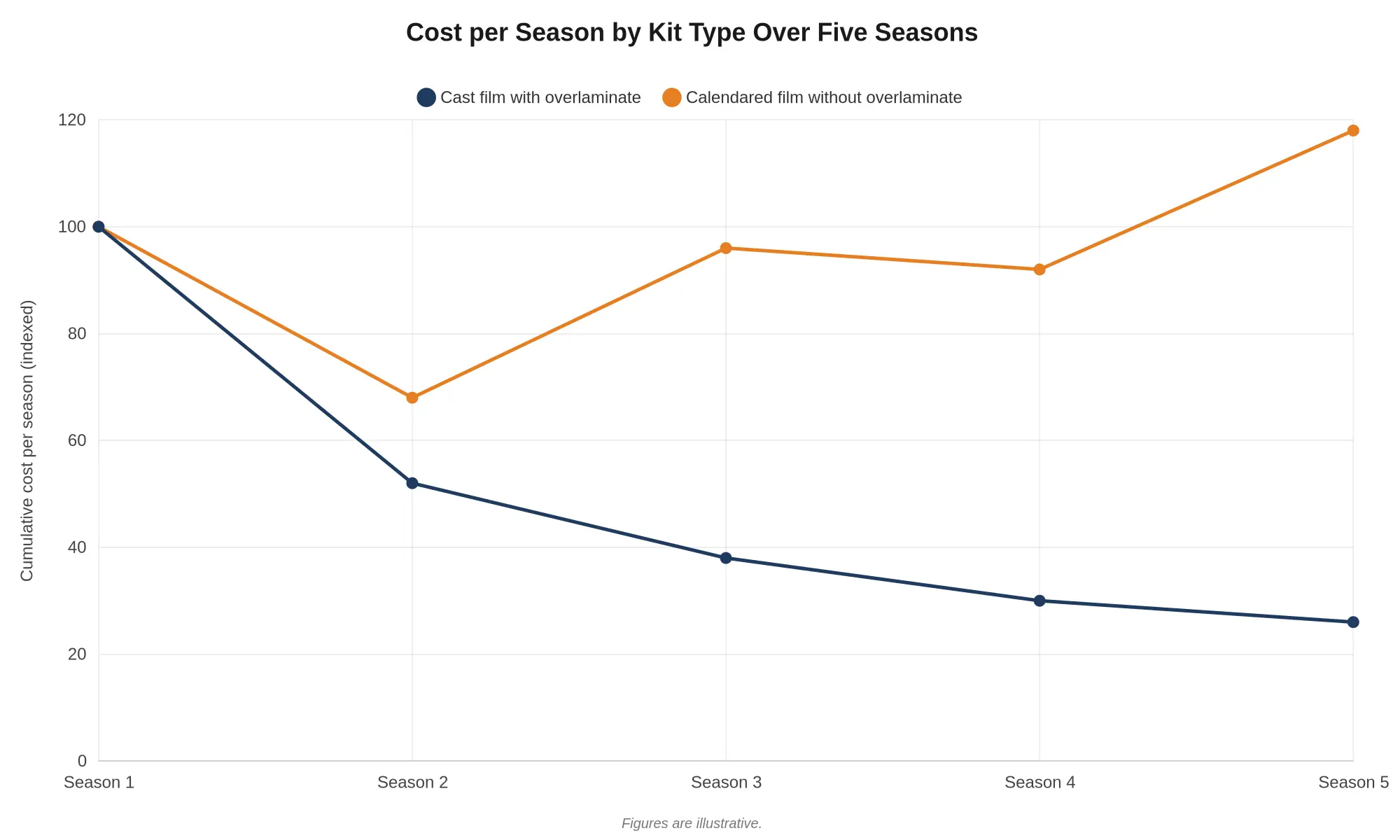
Data note: The indexed figures in this chart are illustrative and are meant to show the shape of the trend, not exact retail prices.
If you are weighing that against your own riding, start with kits built on cast film under a laminated overlaminate layer. Our KTM graphics kits show the construction on each listing.
How to read it: a flat line means the money is already spent and working for you, a rising line means you are about to pay for the same real estate on your plastics again.
What an Overlaminate Actually Protects Against
The overlaminate is the clear top layer bonded over printed vinyl, and it determines how long printed dirt bike graphics stay legible. Cast film carries the pigment; the overlaminate decides how much of that pigment survives a season.
- UV light degrades pigment over time, and a fade-resistant overlaminate filters that light before it reaches the ink.
- Pressure-washer spray and detergent attack exposed edges first, so the overlaminate takes that load instead of the print.
- Roost and gravel off the rear wheel abrade side panels and fenders, and the clear layer absorbs that scuffing.
- Fuel spills and solvent wipes soften unprotected vinyl; a cured overlaminate slows chemical penetration at the surface.
- Boots and knee braces rub shroud edges constantly, and a thicker overlaminate spreads that friction over a wider area.
- Mud particles lodge in textured or worn vinyl; a smooth overlaminate limits staining that normal washing cannot lift.
Each item above decides how soon a panel becomes unreadable, and that sets the replacement interval. Longer intervals spread the kit price across more seasons, which is how graphics kit durability turns into cost per season. Worth comparing a graphics kit that holds its print longer before you buy.
Three-Season Total Spend: Where the Cheap Sticker Stops Winning
The same ownership picture, priced out. The chart below stacks the sticker price you see at checkout against what you actually pay across three seasons once replacement kits and install consumables (prep spray, applicator fluid, squeegee blades, edge sealer) are counted in.
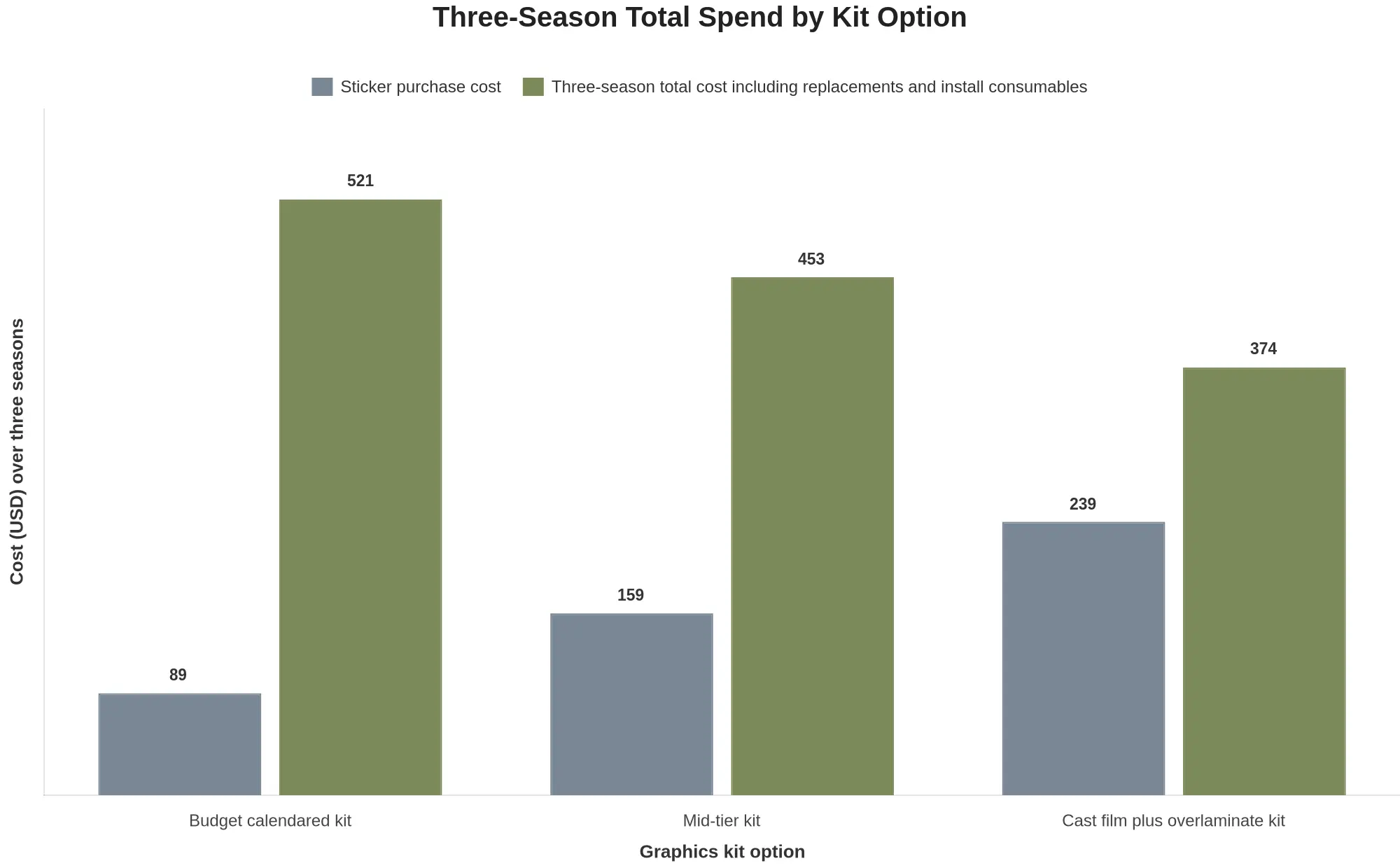
Caption: The $89 budget kit costs $521 over three seasons; the $239 cast film plus overlaminate kit costs $374 – the cheapest sticker loses.
Reading the bars
- Budget calendared kit – $89 up front, but it needs around four kits across three seasons plus more prep time, landing at $521.
- Mid-tier kit – $159 up front and roughly two kits over three seasons, totaling $453.
- Cast film plus overlaminate kit – $239 up front, one install, $374 total. It is the most expensive sticker and the cheapest three seasons.
The gap widens the harder you ride: mud, pressure washing and repeated removal all punish calendared film first. That $147 is not a discount printed on a price tag. You get it by installing once instead of four times. Riders re-graphic-ing a KTM this season can compare KTM graphics kits built on cast film and judge the construction rather than the sticker count.
Match the Kit to the Bike, Then Judge the Filings
Cut accuracy and model-specific panel layouts decide how much of a motocross graphics kit actually ends up on the bike. A precise template wraps shrouds and side plates fully, so fewer dirt bike graphics panels peel early and cost per season falls.
- KTM graphics follow stock shroud contours, so edges stay seated through mud and wash cycles.
- Surron Light Bee graphics match the battery cover, reducing lift where panels flex most.
- Talaria XXX graphics cut to the frame guards, limiting the trimmed waste you pay for.
- Stark Varg graphics track the MX/EX bodywork, keeping coverage tight as panels heat up.
- 79Bike graphics fit the stock plastics, so fewer pieces need replacing mid-season.
Install and Care Habits That Stretch Service Life
Install quality and wash technique move measured service life enough to change cost per season. A cast film kit applied correctly to a clean surface routinely outlasts one slapped on in a hurry.
Degrease and dry the panels first; wipe with isopropyl alcohol and let it flash off completely. Apply at 20-25°C (68-77°F) so the adhesive stays workable. On curved panels, anchor the vinyl at the center, then squeegee outward in short, firm, overlapping strokes. Lift and re-lay rather than stretching the film.
A top-quality overlaminate still needs correct application to bond fully, and a lifted edge cancels the UV and abrasion protection you paid for. Keep high-pressure spray away from decal edges, since water driven under a lift releases the adhesive. Skip solvent-based cleaners; pH-neutral soap and a soft mitt do the job.
Frequently Asked Questions About Dirt Bike Graphics Lifespan
How long do cast film graphics typically last compared with calendared graphics?
Cast film graphics typically hold up for three to five seasons of regular riding. Calendared graphics usually show peeling, shrinkage and faded color within one to two seasons.
Can an overlaminate be added later?
Yes. It can go on clean, fully cured vinyl at any time, though fitting it at purchase protects the print from the first ride.
Will a kit with fewer pieces still cover the full bike?
Yes. Coverage depends on panel dimensions and shape templates, not piece count, and a well-designed dirt bike graphics kit with twenty precise pieces covers every shroud, fender and plate.
How should cost per season be calculated when a kit is replaced mid-season?
Divide the kit price by the months it actually served, then annualize that monthly figure. A mid-season replacement covers fewer months, so the annual number rises.
Do gloss and matte overlaminates differ in durability?
Both use the same protective film chemistry, so lifespan and abrasion resistance are equal. The matte finish hides scratches better, while gloss wipes clean more easily.
Are model-specific kits worth the price difference?
Yes. Model-specific kits fit factory contours without trimming and hold edges down at speed, so they outlast trimmed universal sheets and lower cost per season.
Final Buying Checklist: Decide by Cost per Season
Before you commit to any kit, run these six checks in order.
- Confirm the base film is cast vinyl, not calendared, because cast conforms, resists shrinkage and lasts longer.
- Confirm a protective overlaminate is included, since it shields prints from roost, fuel and UV fade.
- Confirm the cut is model-specific for your exact bike, not a universal trim-to-fit sheet.
- Estimate realistic seasons of service from film type and overlaminate quality before comparing any prices.
- Add install consumables and shipping to the numerator so your total reflects the true out-the-door cost.
- Divide that total by expected seasons to get cost per season, then rank every kit on that number.
Price a kit by cost per season, not by sticker count, and weigh cast film plus overlaminate before you buy. A cheap calendared set that dies in one season costs more than a durable cast kit that lasts three. Start with a model-specific listing such as Talaria MX5 graphics kits, then run the numbers yourself.