
Dirt Bike Number Plate Graphics: Matte vs Gloss Overlaminate in Mud and Wash Cycles
What Dirt Bike Number Plate Graphics Are, and What This Article Compares
Dirt bike number plate graphics are printed vinyl decals with a protective overlaminate film laminated over the print. The print carries the design; the overlaminate takes the wear. Which film you specify decides how mud clings to the plate, how much work it takes to clean, and how the graphics look after a season of washing.
For shop owners and resellers that is a specification decision rather than a cosmetic one. It shows up in cleaning complaints, return rates and repeat orders from customers who ride in wet, gritty conditions.
Below, both finishes are judged on the same three points: surface texture and mud adhesion, the cleaning effort a muddy ride leaves behind, and the wear each finish develops across repeated wash cycles.
What Overlaminate Actually Does
Number plate graphics are built in two passes. Adhesive-backed printed vinyl goes onto the rigid plate first and is conformed around its edges and curves; the protective film is laminated over the top. The finished part is a three-layer stack of plate, print and film.
The film does four jobs:
- UV resistance: absorbers in the film take UV energy that would otherwise reach the ink, slowing colour fade in sustained sunlight.
- Abrasion resistance: it is a sacrificial layer, so roost, boot scuffs and brush contact damage the film instead of the print.
- Chemical resistance: it stands up to brief contact with workshop cleaners, degreasers and fuel spills that would soften or stain bare ink.
- Surface texture: the top coat decides whether light scatters across the plate as a matte finish or reflects as a clean gloss.
Fade resistance depends on both the ink set and the overlaminate, which is why “fade-resistant vinyl decals” is only an accurate claim when both are specified. Both finishes are available across our KTM graphics kits.
The arrows show the direction of lamination: the film is applied last, pressed onto printed vinyl that is already bonded to the plate. That order matters, because the top layer is the only one your sponge, hose and mud actually touch.
Matte Overlaminate: Mud Behaviour and Surface Feel
Matte overlaminate is a low-sheen film built on a fine micro-texture. The texture diffuses reflection instead of mirroring it, so light scatters and the surface reads flat.
How Mud and Dust Interact With the Texture
Fine particles settle into the micro-texture as the bike is ridden. A quick rinse often leaves a faint film behind, because silt sits in the low points of the surface and resists a splash. A soft brush and a pH-neutral cleaner, worked gently and without much pressure, lift it out.
The trade-off is worth stating plainly. Matte hides fine scratches, scuff marks and swirl marks, which extends the visual service life of the graphics between replacements. In exchange it gives up colour depth: deep tones and metallic finishes look slightly muted, and less light comes back off the surface.
Matte vs Gloss Overlaminate: Side-by-Side Comparison
The table gathers the matte and gloss points made in the sections either side of it, so the two finishes can be weighed at a glance before a print run is committed.
| Attribute | Matte Overlaminate | Gloss Overlaminate |
|---|---|---|
| Surface sheen and reflectivity | Soft low-sheen finish; scatters light, minimal glare | Mirror-like gloss finish; strong direct reflections |
| Mud and fine dust adhesion | Textured face grips fine dust; mud clings longer | Smooth face releases wet mud faster |
| Cleaning effort after repeated wash cycles | More scrubbing per wash; texture traps residue | Wipes clean in fewer passes; less elbow grease |
| Visibility of scratches and scuffs | Hides fine scratches; scuffs blend into texture | Shows fine scratches clearly; marks stay visible |
| Colour depth and vibrancy | Muted, flat tone; deeper understated look | Rich saturated colour; printed graphics pop |
| UV and fade resistance | Same absorbers as gloss; dirt held in the texture can read as chalky | Same absorbers as matte; a clearer surface keeps colour looking brighter |
| Tolerance to pressure washing | Edge failure is the limit, not the texture; keep the nozzle moving | Same limit; water forced under an edge lifts the film |
| Best-fit use case for number plate graphics | Mud-heavy enduro, trail riding, understated brand look | Race-day presentation, sponsor visibility, quick post-wash cleaning |
One practical note for ordering: laminate quality and a clean, bubble-free fit influence wear far more than the sheen does, so buy both finishes at the same film grade from one supplier if you want a fleet to age evenly.
Gloss Overlaminate: Mud Release and Colour Depth
Gloss overlaminate is a smooth, low-porosity film that gives the plate a continuous reflective surface. With no micro-texture to grip, mud releases more readily during a rinse, and water sheds in sheets rather than clinging in droplets. Fewer particles are left on the plate after each wash.
The cost of that is visibility. Gloss shows fine scuff marks, wash swirls and dried water spots clearly, and riders who pressure-wash often notice them early. A soft cloth dry after every wash limits the spotting. Gloss also carries stronger colour saturation, so printed number plate graphics stay legible in low light. Buyers should set that visibility against the mud release and accept that a gloss finish shows wear as part of normal use.
How Matte and Gloss Overlaminate Age Across Wash Cycles
Nobody judges a number plate kit on day one. The verdict arrives around the tenth pressure-wash, once the mud has been hosed off, the sponge has done its work and the sun has baked the panel dry a few dozen times. That is the point where the choice between matte and gloss stops being a styling preference and becomes a durability question, and it is the question that decides reorders for shops and teams buying in volume, whether they stock our KTM graphics range or kit out a mixed fleet.
The chart tracks how much of its original surface quality each finish holds as wash cycles pile up, from a fresh install through thirty cycles of mud, spray and scrubbing.
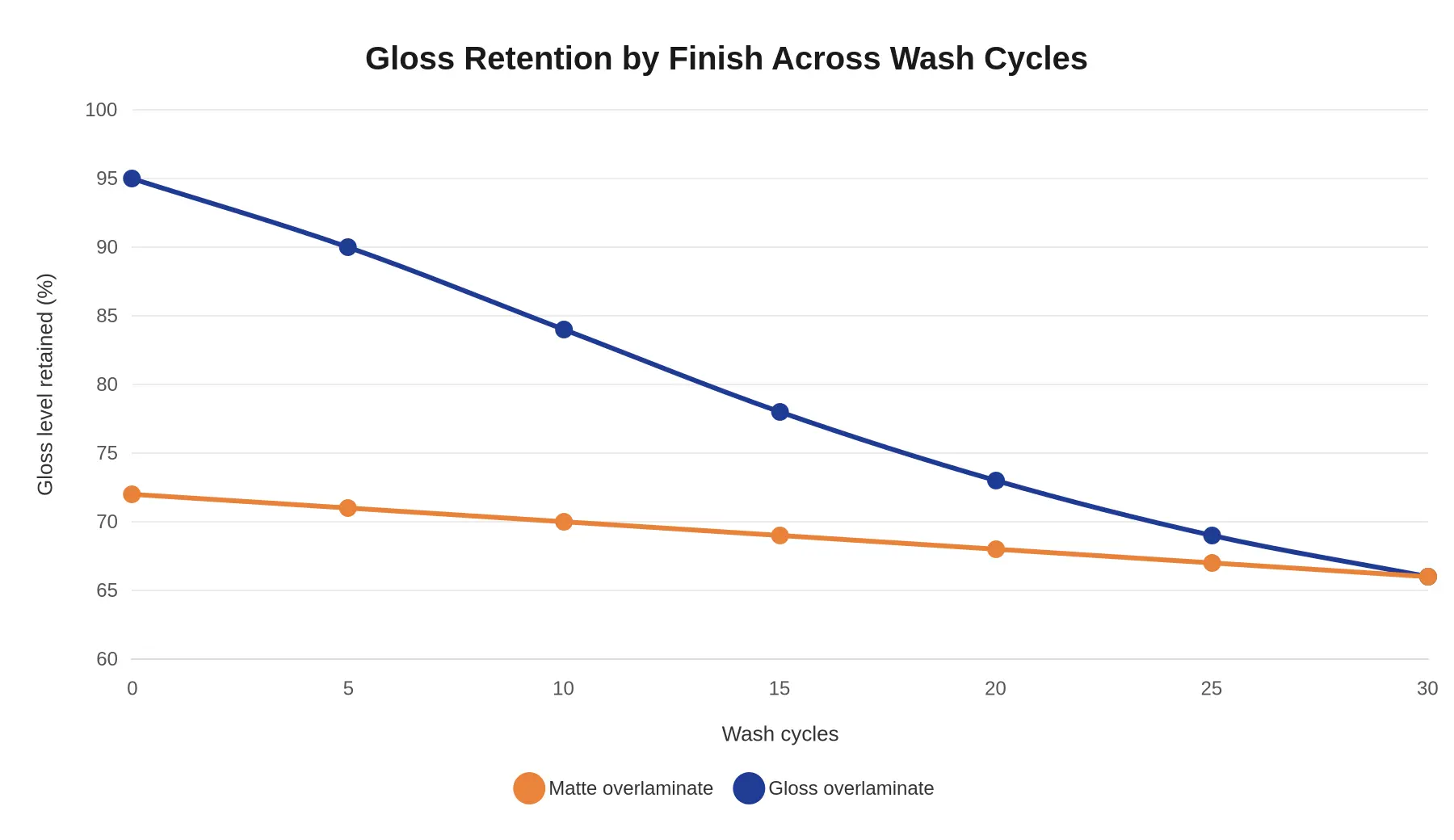
The chart shows relative trends in finish behaviour rather than measured test data.
What the two curves tell you
- Matte overlaminate starts lower but holds its ground. From roughly 72 percent it barely moves, losing only a few points across thirty cycles. With no mirror depth to lose, the surface looks close to new for longer.
- Gloss overlaminate starts high and gives up ground steadily. It begins near 95 percent, the deep, wet-looking shine customers notice immediately, then slides down a smooth, predictable gradient.
- The lines meet at the end. By cycle 30 both finishes sit in the same range, so the choice is about when you want the visual payoff, not whether one finish survives.
For a business owner the consequence is straightforward. Gloss sells the look on the showroom floor and through the first few months of ownership; matte sells consistency to the rider who washes after every ride. Customers who jet-wash weekly will shift mud off gloss with the fewest passes, but a glossy plate records those habits sooner, so gloss buyers need the gentler routine: low pressure, pH-neutral soap, no aggressive degreaser on the laminate. Matte forgives a hurried dry and asks for a soft brush instead.
Either way, laminate quality matters more than the sheen. A thick, UV-stable film on a properly degreased plate is what keeps both curves higher for longer.
How Wash Cycles Affect Both Finishes
Mud gets the attention, but washing does as much damage. The way a bike is washed decides whether the graphics still look presentable after twenty race weekends or start lifting by August. Three variables do most of the harm: pressure and spray angle, detergent chemistry, and mechanical abrasion.
Pressure is the one most riders get wrong. A jet held close to the edge of a plate can force water under the laminate and lift it, turning a small bubble into a curled corner. Solvent-heavy cleaners attack the film surface and leave it chalky and dull. Abrasion takes the shine: stiff brushes dull gloss faster than matte, which hides fine scratches better.
The Recommended Wash Routine
- Rinse loose mud off first, before you touch the surface.
- Use a pH-neutral cleaner rather than a solvent-heavy degreaser.
- Work a soft brush gently over textured matte film.
- Keep the nozzle at a reasonable distance and away from the edges.
- Dry the plate to prevent water spotting.
Edge sealing and correct application count for as much as the film itself. Browsing our KTM graphics kits shows how properly finished plates are built to survive real wash cycles.
Choosing Between Matte and Gloss
Run these seven checks before you commit a stock order, because the right answer shifts with how your customers actually ride. If the kit artwork is still open, ready-made graphics kits are the faster route.
- Matching existing plastics: Align the overlaminate sheen with the shrouds, seat and graphics already fitted, so panels read as one factory set.
- Mud exposure: If the bike is seen dirty more often than clean, matte hides the dried crust between wash days; if it is hosed down after every ride, gloss sheds the mud faster.
- Cleaning method: Pressure washers and stiff brushes punish gloss; hand washing with soft cloths suits either finish.
- Scratch tolerance: Comfortable with visible scuffs? Gloss holds up. Not? Matte swallows boot rub and branch strikes.
- Colour vibrancy vs low glare: Showroom impact favours gloss, bright-daylight riding favours glare-free matte.
- Budget per set: Compare prices at the same film grade and thickness, then weigh the gap against how often the kit is replaced.
- Replacement cycle: Short refresh cycles suit whichever finish costs less at equal grade; long cycles justify paying for the film that holds its look longest.
Stocking and Recommending the Right Finish
Buying graphics in volume is mostly a matter of matching stock to demand, so keep both matte and gloss on the shelf for your high-turnover number plate sets. A single-finish shelf turns away the customer who cleans their bike the other way. Price replacement sets around a realistic wash-cycle life, and say so plainly: these are wear parts, and buyers accept that when the price reflects it.
Ask how a customer washes. Riders who scrub by hand and hose down usually get on well with matte, which hides fine scratches. Pressure-washer users and polish fans do better with gloss, since it wipes clean and keeps its shine, provided they keep the nozzle off the edges.
Which kit people ask for also follows the model. Gloss suits race-day builds in the KTM graphics range, while Light Bee graphics sold to commuters sit better in matte. Keep a spread across Talaria MX3 MX4 graphics so you can advise rather than guess. Gloss also suits faster e-moto builds, so carry it in your Stark Varg MX and EX graphics lineup, and let e-ride graphics lean matte for daily riders. Then reorder what actually leaves the shelf.
Frequently Asked Questions
Does matte overlaminate wear out faster in mud than gloss overlaminate?
Matte’s micro-texture holds fine grit against the surface a little longer, so abrasive mud can dull it at a marginally faster rate. Gloss sheds wet mud more readily, though it shows the scratches it picks up more clearly. In practice the difference is small and usually secondary to how well the plate edges are sealed.
Can a pressure washer damage number plate graphics regardless of finish?
Yes. High-pressure water can lift a laminate at edges, seams and bolt holes on either finish, because the failure point is adhesion and edge integrity, not surface texture. Keep the nozzle at a distance, use a wide fan, and avoid directing spray at the plate’s perimeter. A properly applied laminate is not porous, so the face does not soak up water. The risk is direct pressure finding a weak edge.
Does gloss overlaminate fade faster in sunlight than matte?
Not meaningfully. UV resistance comes from the laminate’s UV absorbers and the base ink set, not from whether the surface is matte or gloss. Matte scatters light and looks chalky once dirt builds in its texture, which is sometimes mistaken for fading. Store bikes out of direct sun where you can, and both finishes age at a comparable rate.
Which finish holds up better across long-term wash cycles?
On the sheen reading, gloss starts closer to new and loses gloss level steadily, while matte starts lower and stays close to where it began. On film integrity, gloss has one advantage: dirt lifts off a smooth surface with less rubbing, so it takes less brush work. A matte panel scrubbed hard in the same spot will slowly polish to a sheen. Past a few dozen cycles, edge sealing decides more than either finish. If plates are replaced regularly, browse our pre-cut number plate graphics with sealed edges.
The Practical Takeaway
Matte overlaminate hides scratches and reduces glare, and it holds fine dust in its texture. Gloss overlaminate releases mud easily and shows colour at its deepest, and it reveals scuffs sooner. Neither wins outright, so pick the finish that matches the riding and the wash routine.
The finish is only part of the result. Correct application, sealed edges and a disciplined wash routine carry as much weight as matte or gloss. Motograpics supplies fade-resistant vinyl decals for motorcycle graphics, so the finish you choose keeps its colour through mud and wash cycles.